For dogs, Halloween is rarely a costume question. It is a safety question: what is within reach, what happens at the door, what is going on outside? Here is what matters on October 31.
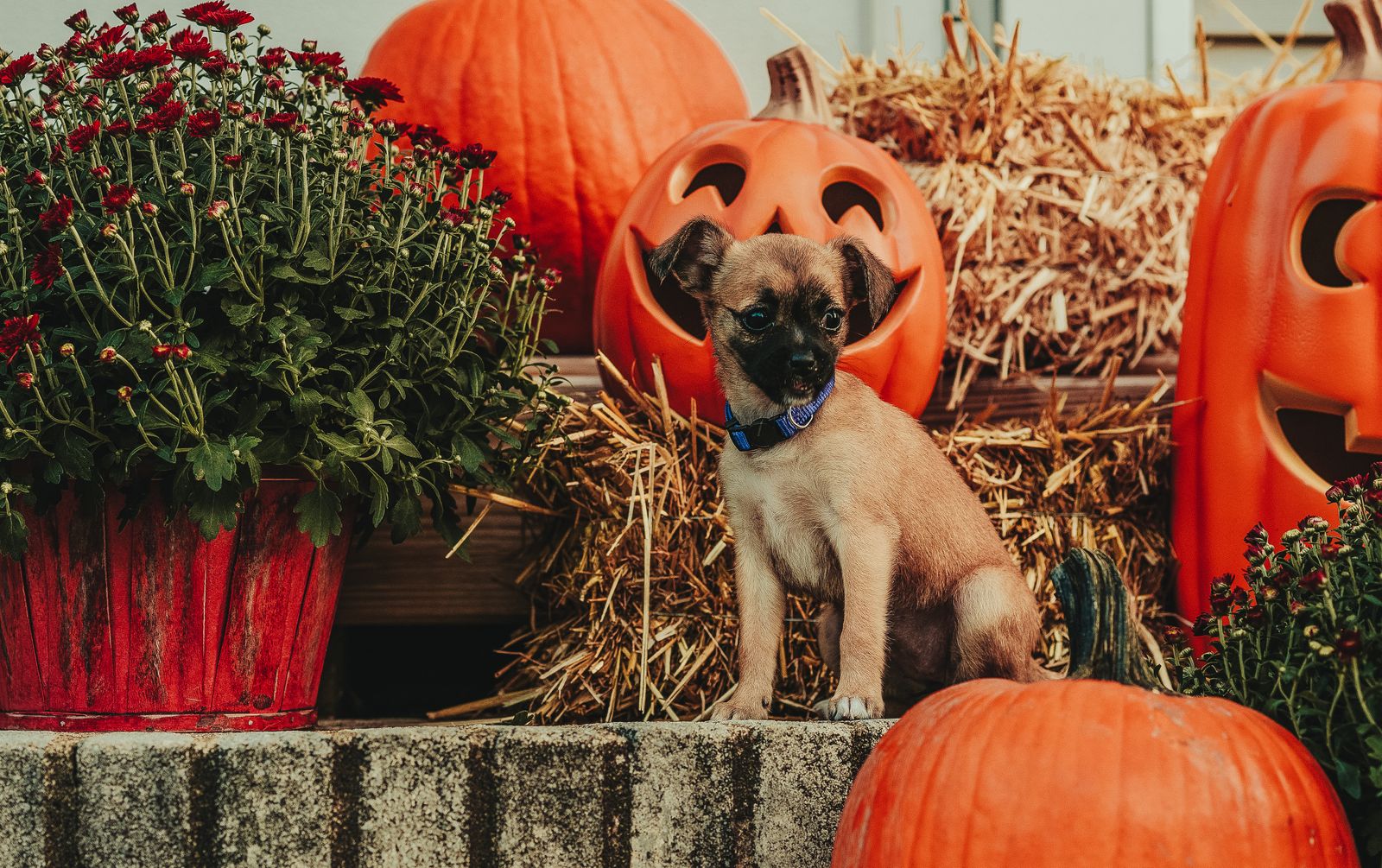
t is half past six on October 31. The bowl of candy sits ready in the hallway, the pumpkin on the windowsill grins its triangle grin, and your dog lies with his head on your feet, very relaxed and very alert. He has worked out that something in the hallway smells good. And any minute now the doorbell starts.
When people think of Halloween with a dog, they think of costumes first. Search for halloween dog and you get outfits, decorations and toys. What decides the evening for your dog is something else: what he can eat, what happens at the door and what lies within his reach. Costumes get only a short section here, because we have separate articles on them.
Once you have thought this through, the evening itself is just carrying it out. The rest of this article goes through the points in order, with the numbers that belong to them.
Chocolate contains theobromine and caffeine, together called methylxanthines. Both act on the heart and the nervous system. What counts is the cocoa content: cocoa powder and baking chocolate contain many times the toxin of milk chocolate, white chocolate only traces.
The MSD Veterinary Manual gives this as a guide: from about 20 mg of methylxanthines per kilogram of body weight, vomiting, diarrhea and increased thirst are possible. From 40 to 50 mg/kg, a racing heart and heart rhythm disturbances threaten, from about 60 mg/kg seizures. Severe outcomes are possible at lower amounts too, because dogs react differently. Signs often begin only 6 to 12 hours later and can last up to 72 hours. Waiting for symptoms is therefore not an option.
The table below converts the 20 mg/kg threshold into grams. It is a guide, not a green light: cocoa content differs between products, and fillings can contain other toxins.
| Type (MSD value per g) | from approx. at 2.35 kg (toy poodle) | from approx. at 10 kg | from approx. at 30 kg |
|---|---|---|---|
| Cocoa powder (28.5 mg) | 1.7 g | 7 g | 21 g |
| Baking chocolate (15.5 mg) | 3 g | 13 g | 39 g |
| Dark chocolate (5.6 mg) | 8 g | 36 g | 107 g |
| Milk chocolate (2.3 mg) | 20 g | 87 g | 261 g |
For a small dog, that is only a few small pieces of dark chocolate. Whether a particular amount is harmless can only be judged with the type, the amount and the weight. When in doubt, ask at the vet practice. The poison list entries for chocolate and cocoa show symptoms and assessment (in German).
Xylitol, also called birch sugar or E 967, is in sugar-free gum, some candies, oral care products and baked goods. People tolerate it well. In dogs it triggers a strong release of insulin.
According to MSD, low blood sugar threatens from about 0.1 g per kilogram of body weight, and liver damage can occur from about 0.5 g/kg. Blood sugar often drops within about 30 minutes, sometimes only after several hours when absorption is delayed. Liver damage often shows only after 24 to 48 hours. A small dog reaches these amounts quickly: at 3 kg of body weight, 0.1 g per kg is just 300 milligrams.
What matters at Halloween: not every candy contains xylitol, but some sugar-free sweets do. So read the ingredient list on gum, candies and anything advertised as sugar-free. If you find xylitol or E 967, the emergency steps below apply, even if your dog looks fine. The matching poison list entries are xylitol, gum with xylitol and sugar-free candies (in German).
A Halloween bowl holds more than chocolate, and every part has its own risk.
Raisins and grapes can cause kidney damage up to kidney failure. No safe amount is known. That also applies to raisins in chocolate, baked goods and muesli, which makes chocolate-covered raisins doubly critical. The poison list entry is grapes and raisins (in German).
Macadamia nuts are toxic to dogs. Signs are weakness, vomiting, tremors and fever, usually within 12 hours. Candy containing alcohol can cause vomiting, loss of coordination and breathing problems.
Then there are foil, cellophane and candy wrappers. They can lodge in the intestine and cause a blockage that needs surgery. Warning signs are vomiting, loss of appetite, trouble passing stool and lethargy. So do not put empty wrappers in an open trash can either.
What else dogs may or may not eat is sorted in our overview What can dogs eat (in German).
Look up the number of the emergency vet service near you before the evening and save it in your phone. When it is late and the doorbell rings, there is no time to search.
When the bell rings, strangers stand outside, often in costumes and masks, sometimes in groups. The ASPCA points out that crowds and strange costumes can spook pets, and the AVMA recommends moving sensitive animals to a room away from the front door. Covered faces, capes and unfamiliar outlines are hard for many dogs to read. You know best whether your dog is one of them.
What helps in practice:
Set up the retreat early, before the first ring. A room away from the door, window and shutters closed, radio or steady background noise on, water, a soft bed and a chew. The dog should know the room as a quiet place, not as a punishment.
Put the candy bowl outside the door or at the garden fence, tape over the doorbell and hang a sign saying everyone may take a handful. That saves you a hundred trips to the door and your dog a hundred barks. If you do open the door, secure the dog first, because that is when one is most likely to slip out.
If your dog tends to react to doorbells, train the signal beforehand with a replacement behavior, for example the cue to go to his blanket, followed by a reward. If you only start on the 31st, you overwhelm both of you. For strong anxiety, talk to your vet beforehand about support.
A microchip only helps if the contact details at the pet registry are current, and an address tag on the collar can be read without a scanner. The AVMA recommends exactly this in case a dog slips out through an open door. The microchip checklist is in the article Dog on New Year's Eve.
Even if your dog loves people, he does not come along on the round through the streets. It is dark, many people are in costume, children run and shout, and bags of candy are everywhere at paw height. The ASPCA points out that commotion and strange costumes can make animals bolt. A frightened dog that wriggles out of a collar or harness is hard to find at night.
If your dog needs his evening walk anyway, go early, before dusk, on quiet routes and not through the streets where the children are out.
Candles and jack-o'-lanterns. Open flames belong out of reach, tail included. Pet Poison Helpline and the AVMA advise keeping burning candles and lit pumpkins away from pets. LED lights remove the risk entirely. The pumpkin itself is not the problem, but chewed or moldy lantern leftovers are something your dog should not eat.
Glow sticks. They contain dibutyl phthalate. It tastes bitter and leads to drooling, gagging and irritation of the mouth and eyes. The AVMA and Pet Poison Helpline rate the effect as usually mild. Wipe the mouth and tongue with a damp cloth, offer water, and call the vet practice if your dog swallowed the whole stick or seems very distressed.
Batteries. Blinking decorations and costume parts can contain button batteries. They are an emergency even without symptoms: Pet Poison Helpline advises going to the vet immediately without inducing vomiting, because lithium button batteries can seriously damage the esophagus within 15 to 30 minutes. Details in the entry button cell (in German).
Strings of lights and extension cords on the floor are something to chew for many dogs. Lay them out of reach and never plug a gnawed cable back in.
Fake blood and makeup do not belong on the dog or in his coat. Pet Poison Helpline advises checking with a vet before coloring fur, because a product that is harmless for people can still harm animals. If your dog licks paint or fake blood, wipe him off and ask at the practice if it was more than a dab.
If your dog wears a costume, then only like this: it must not restrict sight, hearing, breathing or movement, you practice wearing it beforehand, and you take it off as soon as he shows stress. Small dangling parts are a swallowing risk. Everything else is in the articles Dog costumes 2026 and Matching costumes with your dog. Even the most popular costume is no reason to dress up a dog who does not like it.
The last round happens in the dark. Visibility counts, best with a light-up collar or reflective strips on the harness. What really makes you visible is in the article Dog walks in the dark.
Around Halloween there are scattered bangs, not area-wide fireworks as on New Year's Eve. For dogs with noise anxiety that can still be enough. Keep the leash short and secure harness and collar twice. Training against fear of bangs is described in the article Fear of fireworks in dogs.
In the end, Halloween with a dog is mostly logistics: sweets out of reach, a quiet room, a chip with current details and the emergency vet's number in your phone. After that you can enjoy the spooky mood, with a dog lying contentedly on his blanket who barely notices the doorbell.
In the Souldog app you will find the poison list with more than 200 entries, including chocolate, xylitol and raisins, each with symptoms and an assessment of when it is an emergency. For an overview of prevention and safety, see our big health guide (in German).
 Souldog