By October, your evening walk happens in the dark. Your dog sees better than you do, but he's still harder to see. Here are the numbers that matter, and which of them are actually worth spending money on.
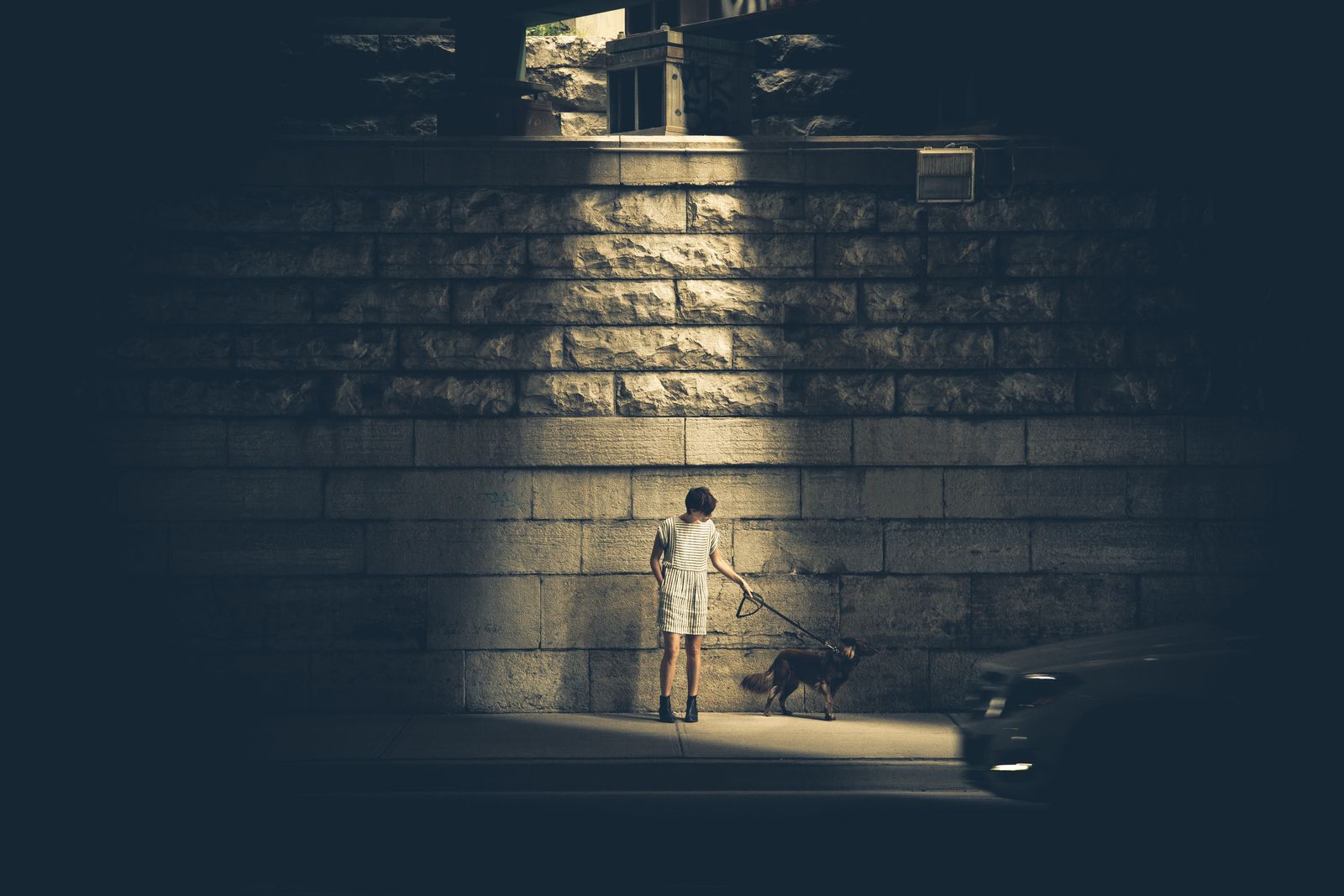
It's five thirty, you're standing at the door with the leash in hand, and outside it's already night again. Your dog doesn't care what time it is, tail wagging away. So off you go: black jacket, black dog, wet asphalt. At the first intersection, a car brakes later than you'd like, and for a moment your heart stops.
hat scene comes with a number, and it's an uncomfortable one. A person in dark clothing is often only visible to drivers from about 25 meters (80 feet) away. In Germany, a car traveling at 50 km/h (about 31 mph, the standard in-town speed limit) already needs around 28 meters (90 feet) to come to a full stop in an emergency. Do the math for a second: if a driver only sees you once it's too late to stop anyway, you're not looking at a close call anymore, just luck. With reflective material, the same driver can spot you from up to 140 meters (460 feet) away. That's nearly six times farther, and it's the whole difference between a near miss and too late.
The two techniques solve different problems, which is exactly why they work so well together. Reflective material needs a light source to shine on it; without headlights, it stays dark. On the plus side, it needs no battery, never runs out, and works exactly where it counts, right in the beam of an oncoming car. Active light, on the other hand, glows on its own, even on an unlit dirt path where no car will ever pass; the downside is the battery can die, usually right when you forgot to check it.
| Reflectors (passive) | LED gear (active) | |
|---|---|---|
| Works | when light hits it | always, even without other light sources |
| Strength | street traffic, headlights | dirt paths, parks, staying visible to you |
| Weakness | useless in a dark forest | battery can die |
| Upkeep | none | charge, check, inspect battery compartment |
Two details make the real difference. First, coverage: a reflective strip that wraps all the way around the harness is visible from the side too, while a small tag on the collar only shows up from the front. Second, where your dog actually is. A dog on a retractable leash can be standing ten meters away (about 33 feet) when a car approaches, effectively becoming its own separate hazard in traffic. If you're walking along a street in the dark, it's smarter to shorten the leash and keep your dog on the side facing away from traffic.
There's no dog-specific research comparing steady light to blinking light, but there's a solid analogy from cycling: blinking grabs attention but makes it harder for drivers to judge distance. A steady light as your base, with blinking as an optional extra at most, is the smarter order of priority.
Yes, and much better than you. Dog eyes have more light-sensitive rod cells than ours, a larger pupil, and the tapetum lucidum, a reflective layer behind the retina. It bounces incoming light back onto the sensory cells a second time, turning a little light into a lot more information. You've seen the side effect in every nighttime phone photo: those glowing greenish eyes.
Your dog also sees color differently than you do. Dogs are dichromats: they have two types of cone cells instead of three, and mainly perceive blues and yellows, while red and green blur together into a grayish brown. For toy shopping, that means the red ball on the lawn is basically a game of hide and seek for your dog, while the blue one isn't.
And still, your dog's excellent night vision doesn't change the core issue. He can see the car. The car can't see him. Visibility isn't a sensory problem for your dog. It's a problem for the people around you.
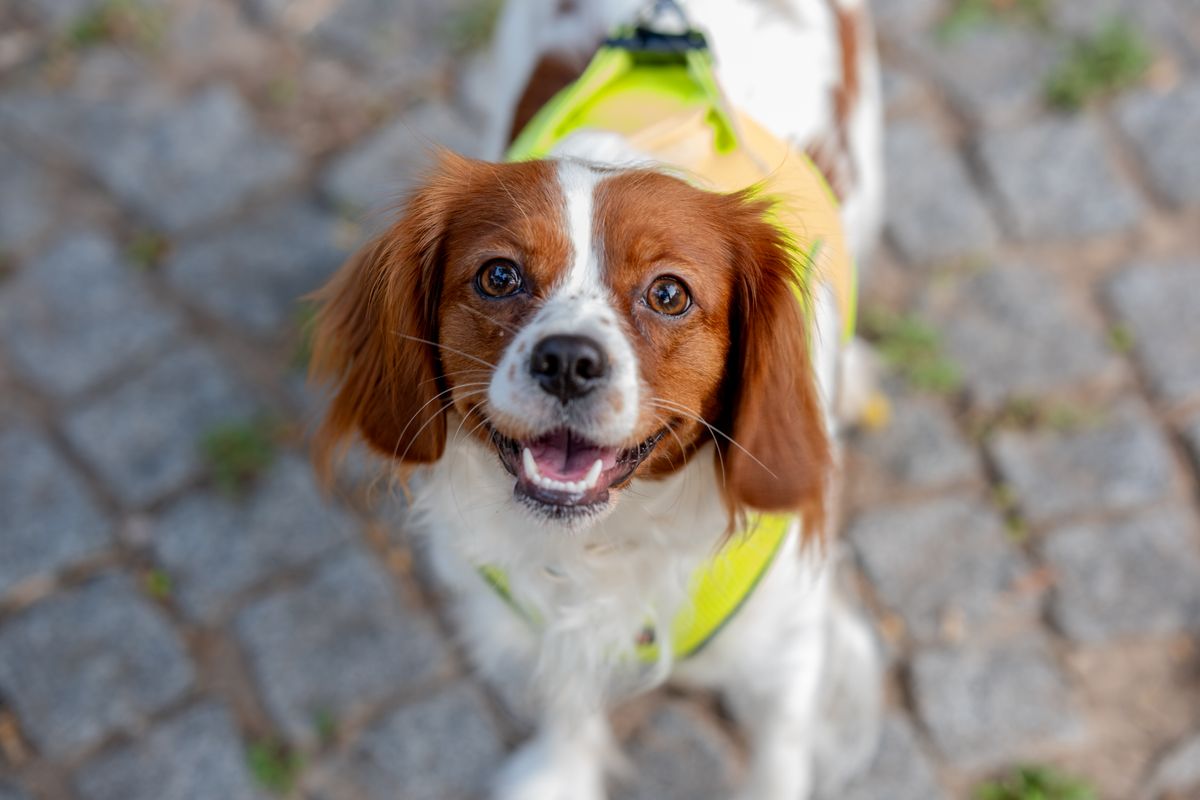
Most owners gear up their dog and forget about themselves. But you're the bigger body, and you're the one walking between your dog and traffic. What helps is refreshingly unglamorous: a jacket with reflective elements or a light safety vest over your coat, a headlamp or flashlight, and when you cross the street, a quick sweep of the light toward yourself so the driver sees a person, not just a point of light.
A headlamp has a second benefit you only really learn to appreciate in fall: you can see what your dog is heading toward. Digging through your pocket for a poop bag in the dark, broken glass, muddy ditches, a hedgehog that got hit by a car. You'll only spot most of that if you bring your own light.
A swallowed battery is an emergency. Many light-up tags and LED collars run on button batteries. If your dog swallows one, it can break down in the digestive tract and cause severe chemical burns. Look for battery compartments with secure screws, check them regularly, and if you suspect your dog swallowed one, head to the vet immediately, don't wait it out.
Legally in Germany, there's no requirement to light up dogs or pedestrians. Reflective clothing is a recommendation too, not a rule, and German courts generally won't assign partial fault to someone just for wearing dark clothing, as long as they're otherwise following the rules of the road. That's reassuring to know, and completely useless in the moment that matters: being legally right doesn't help anyone who ends up on the hood of a car. Visibility is self-protection, not a legal question.
Leash rules are a different story. In Germany, whether and when a leash is required is set by individual states and municipalities, often with stricter rules in forests and fields during hunting and nesting season. What applies on your route is posted on local signs and in your municipality's regulations.
Fall is the main hunting season in Germany. Organized drive hunts mostly happen during this time, and many hunting grounds put up warning signs or close temporarily. On top of that, wildlife crosses paths at dusk, right when you're out for your evening walk. For you, that means leashing up near forest edges and fields, even if your dog is normally rock solid with recall. A deer bolting out of the underbrush beats any recall command, and in the dark, you won't find a dog that's taken off after something until he decides to come back on his own.
The second fall effect is about nerves. Darkness changes how your dog processes the world around him: sounds arrive before sights do, people coming toward you seem to appear out of nowhere, and joggers and cyclists turn into fast-moving shadows. Some dogs bark more in the dark, others suddenly won't leave your side. What helps is sticking to familiar routes instead of exploring new ones, keeping plenty of distance during encounters, and a calm word from you before things get tense. If your dog is generally sound sensitive, our post on thunderstorm anxiety in dogs covers the right kind of training; our guide to dog body language explains the subtle stress signals that are easy to miss in the dark.
There's a quiet all its own in these dark walks. Fewer people, fewer dogs, your dog sniffs with real focus, and the street is almost yours alone. These months don't have to be the hardest stretch of the year. They just need about ten more seconds of prep than a summer walk.
If you're wondering where your next evening walk could take you, the Souldog app helps you discover dog-friendly paths and places nearby. And the next time you glance out the window wondering if it's worth it, your dog already has the answer: yes. He always says yes.
 Souldog