



Males 26 to 28 cm and 4 to 6 kg, females 23 to 25 cm and 3.5 to 5 kg: here's how a Coton de Tuléar's size, cotton coat, health and costs fit into your daily life, and what is actually documented about the Madagascar story.
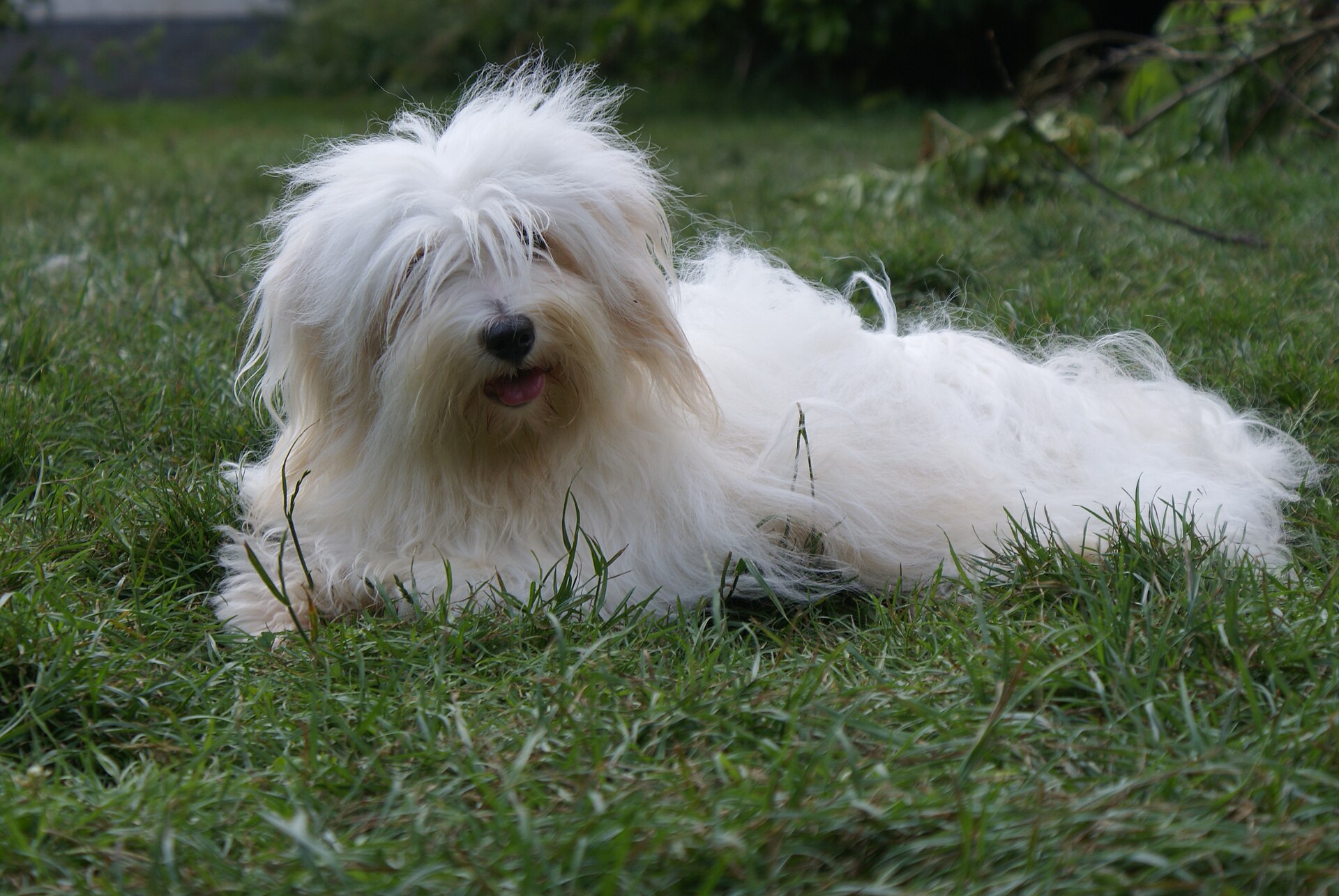
Under the FCI standard, a male Coton de Tuléar stands 26 to 28 cm tall and weighs 4 to a maximum of 6 kg, while a female measures 23 to 25 cm and weighs 3.5 to a maximum of 5 kg. His name translates as "cotton from Tuléar", and that is exactly how the coat feels: soft, dense and a bit like a cotton ball with character. Anyone who sees him for the first time wants to scratch him right away. Whether he really suits you, though, comes down to grooming, time and budget.
elow are the measurements split by sex, the documented health topics with gene tests, the Madagascar legend kept apart from what is documented, and a cost plan without invented prices.
| Trait | Detail | Source |
|---|---|---|
| Origin | Madagascar, patronage France | FCI Standard No. 283 |
| Classification | Group 9, Section 1.2 (Coton de Tuléar) | FCI Standard No. 283 |
| Height at withers | Male 26 to 28 cm, female 23 to 25 cm (tolerance 2 cm above, 1 cm below) | FCI Standard No. 283 |
| Weight | Male 4 to a maximum of 6 kg, female 3.5 to a maximum of 5 kg | FCI Standard No. 283 |
| Coat | very soft, supple, cotton-like, dense, may be very slightly wavy | FCI Standard No. 283 |
| Color | white, light grey or fawn traces on the ears allowed | FCI Standard No. 283 |
| Recognition | by the FCI in 1970 | FCI Standard No. 283 |
| Trait | Male | Female |
|---|---|---|
| Height at withers per standard | 26 to 28 cm | 23 to 25 cm |
| With tolerance | 25 to 30 cm | 22 to 27 cm |
| Weight per standard | 4 to a maximum of 6 kg | 3.5 to a maximum of 5 kg |
You measure the height at the withers from the ground to the spot between the shoulder blades while the dog stands straight. The "22 to 30 cm" you often read is therefore the tolerance limits of both sexes added together, not a figure from the standard. Weights like "4 to 7 kg" don't appear in the FCI standard either; it names a maximum of 6 kg for males and counts size and weight outside the limits as a fault.
The American AKC standard works in inches and pounds and allows more weight: females 8 to 13 pounds (about 3.6 to 5.9 kg), males 9 to 15 pounds (about 4.1 to 6.8 kg). That is a different standard for the same breed and no reason to trim a dog to a target weight.
The standard measurements are not a diagnosis for the individual dog. Whether your Coton has a good weight is something your vet judges from body structure, muscle and fat cover; the WSAVA recommends the Body Condition Score for this. Under fluffy fur, extra weight is barely noticeable, so regular weighing and a hands-on rib check belong in your routine.
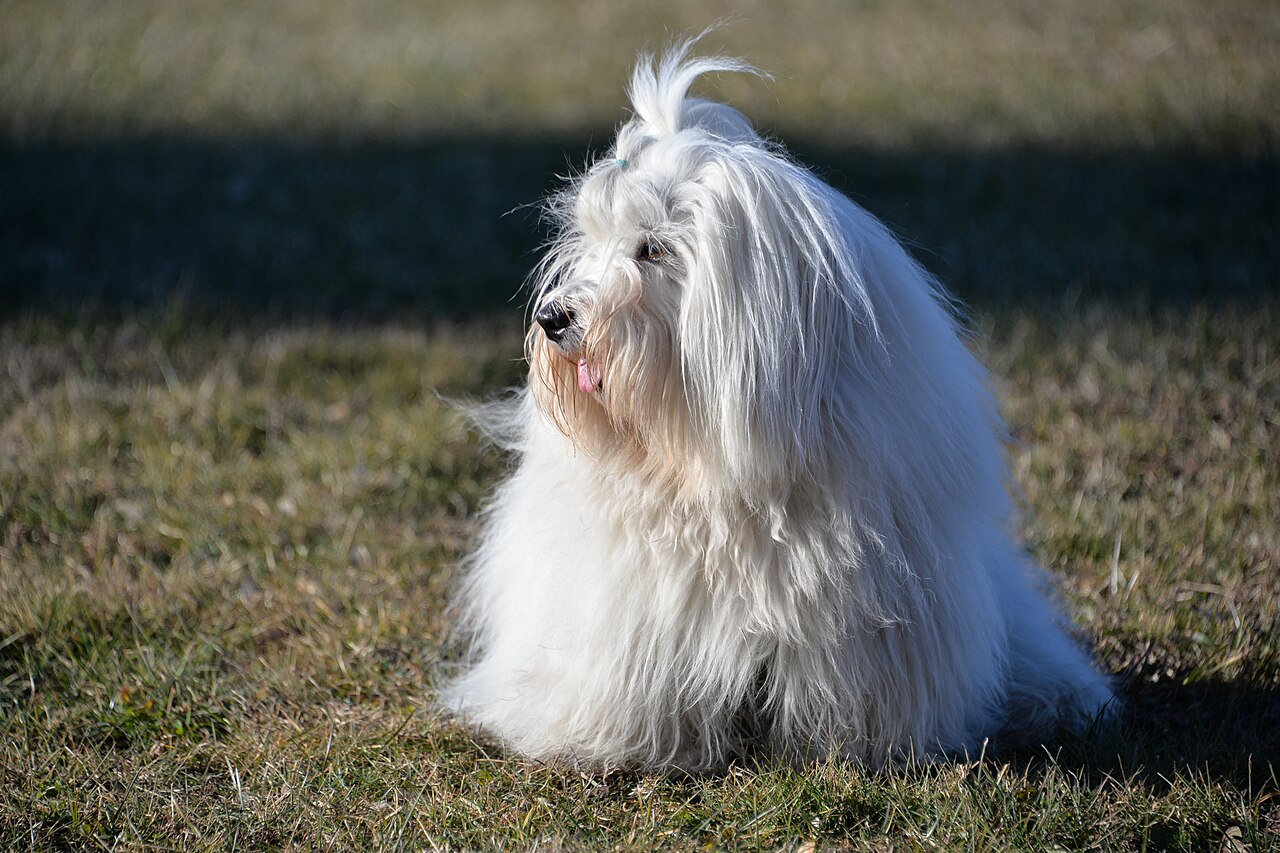
Photo: Sbrandner, CC BY-SA 4.0, via Wikimedia Commons
Cotton ball meets reality: the coat should be "soft and supple, cotton-like, never hard or coarse", dense and abundant. A slight wave is allowed. Stronger curls, on the other hand, count as a fault under the standard, which clearly sets the Coton apart from the curly Bichon Frise.
The base color is white. On the ears, some traces of light grey or fawn ticking are allowed, and on the rest of the body they are tolerated as long as the overall impression stays white; they are not desired. A clearly black patch is a disqualifying fault. So if you see ads for "tricolor" or black Cotons, they don't match the standard. According to the AKC standard, puppies can still carry shades on the body, and the puppy coat is much softer than the later adult coat.
Show ring and living room part ways here. At shows the coat is not supposed to be clipped; the AKC standard penalizes trimming and shaping strictly, and the Royal Kennel Club allows only shortened feet. The Coton de Tuléar Club e.V. writes that the coat is generally not clipped. In family life, a shorter cut is the owner's decision, and there is no tier 1 statement on it. If you have him clipped, talk it through with the groomer first. Even a short cut needs brushing.
On brushing: the club says "ideally daily", and two independent sources (PDSA and Dogs Australia) recommend daily grooming. Dampen the coat lightly before brushing so the hairs don't break, and comb down to the skin, especially behind the ears and in the armpits. You'll find more on the routine for soft coats in the post on grooming poodles, Maltipoos and co..
The standard calls the temperament a central trait of the breed: cheerful, stable and adaptable. The AKC standard speaks of a "naturally clownish" nature. Many owners also report that their Cotons like to stand on their hind legs and dance around. The standard doesn't say that; it's an owner observation.
On the flip side, Cotons are talkative. The AKC describes "unique vocalizations", and the Swedish judges' compendium says they announce visitors long before anyone knocks. If you live in a thin-walled apartment, you should steer barking into manageable channels from the start. Early training and socialization help with that. As for exercise, the standard names no requirement. In many owners' experience, daily walks and play sessions are enough, plus small thinking games or tricks you teach him.
The breed club writes that being alone for hours isn't his thing. There is no fixed number of hours, and how a dog copes alone depends on experience and training. Start in very small steps, for example a few minutes behind a closed door, and build up only as long as your dog stays relaxed. You'll find instructions in the post leaving your dog alone, and for real panic the guide on separation anxiety helps. If your daily life requires long absences, this breed is a difficult choice.
He can suit first-time owners if they have time for grooming and training and can offer the dog company. Before deciding, check who brushes every day, who is there when you're not, and whether you can live with a talkative dog. The standard says the Coton is "very sociable with people". How the individual dog handles children depends on socialization and supervision, not on breed alone. Visit the dog several times before you decide.
"Robust, hardly any hereditary diseases" is what you read on many sites, usually without a source. That is too optimistic. According to its Health Statement, the American breed club (USACTC) recommends an eye examination, a patella examination and a heart examination for breeding dogs, and lists several DNA tests in addition. The hip appears there only as a voluntary extra test.
In patellar luxation, the kneecap jumps out of its groove, and a short hop or limp is typical. It occurs more often in small breeds, and in the Coton too; the parent club names the examination for the CHIC certificate. We could not document a breed-specific frequency.
Eye diseases occur. There is a gene test for a retinal disease (Canine Multifocal Retinopathy, CMR2), and an eye examination of breeding dogs is recommended. A clouding of the lens, redness or sudden tearing should be checked by a vet.
Two hereditary diseases of puppies are documented. Bandera syndrome (neonatal cerebellar ataxia) is autosomal recessive. In the study by Zeng et al. 2011, all 15 affected puppies were homozygous for the same genetic change. Primary hyperoxaluria causes kidney damage through oxalate; Vidgren et al. 2012 described seven affected puppies from four litters, and of 118 Finnish Cotons, 10 were carriers (8.5%). The figures come from Finland and can't be transferred to Germany. Both diseases can be avoided through gene tests of the parent dogs.
Further points are less well documented: for von Willebrand disease and the tendency toward certain urinary stones (hyperuricosuria) there are gene tests, but no frequency figures for the Coton. Hip dysplasia and heart topics are mentioned, but reliable numbers are missing. For skin, allergies and dental problems we found no breed-specific data and therefore make no claim. The term "neuroaxonal dystrophy", which is sometimes named for the Coton, is not the documented disease for this breed.
We found no reliable statistic specifically for the Coton. Breed sites give ranges between 12 and 19 years, without a survey behind them. So don't plan around a single number; plan for a dog who can live with you for many years, and rely on preventive care.
In Germany there are two VDH clubs: the Coton de Tuléar Club e.V. (VDH member since 1986) and the Coton de Tuléar Verein e.V.. According to both clubs, patella and eyes are examined before breeding admission; gene tests and hip X-rays are voluntary with some breeders. We could not view the breeding regulations. So have every result for the parent dogs shown and explained to you. Findings are no guarantee for an individual puppy, but they're an honest start.
Low shedding is not the same as hypoallergenic. A dog breed that is proven allergen-free does not exist. Studies (for example Vredegoor 2012) found no evidence that certain breeds release less allergen. For the Coton there is no study of its own. If you're allergic, you should spend longer time with the specific dog before moving in and talk to your doctor.
The main allergen is found in saliva and dander, not in the hair. That a Coton "sheds little" according to the clubs, and that loose hairs show up when combing, is therefore only an observation about the home, not a statement about allergies. You'll find more on the topic in the overview of small dogs that shed little.
Documented: the Coton comes from Madagascar, and his name means cotton from Tuléar, a port city in the southwest of the island. The FCI recognized the breed in 1970, and the patronage country is France. The standard itself says the Coton was brought to France long before recognition. The AKC recognized the breed in 2014.
Not documented is the story of the shipwreck in which small white dogs swam ashore. It is a tradition, which the Swedish judges' compendium also marks with "according to legend". The same goes for the tale that the white dogs were a privilege of the Malagasy nobility (the Merina) or that the breed is the "national dog" of Madagascar. The AKC standard calls the Coton a companion of the Malagasy nobility but names no primary source, and who is supposed to have granted the status remains open. You're welcome to tell these stories, but you should label them as tradition. What counts as established is what the FCI standard says.
Separate the purchase price from the running costs. We found no reliable puppy price range for Germany: neither the FCI nor the VDH nor the two clubs publish one, and prices from classified ads say little about breeding and health. The Deutscher Tierschutzbund generally cites up to several thousand euros for rare breeds or dogs from breeders. Ask a VDH breeder directly about the total price and the documents included.
The Coton is a rather rare breed in Germany; the Coton de Tuléar Club e.V. describes itself as a pioneer of this rare breed. You'll find current litters on the clubs' litter announcement pages. Expect a wait. Shelters and associations can also place dogs of this breed; a phone call is worth it.
The Tierschutzbund estimates the running costs for a dog at a minimum of 1,200 to 1,350 euros per year (tax, liability insurance, food, vaccinations, deworming), which works out to 100 to 112.50 euros per month. The figure is a minimum estimate for a medium-sized dog, not a Coton flat rate. Vet visits, dog school and grooming come on top.
| Cost item | What to clarify before getting a dog |
|---|---|
| Purchase or adoption | Ask the breeder or shelter for the total price in writing and the documents included |
| Starter equipment | Plan for harness, leash, sleeping place, transport option, brush and comb |
| Food and grooming | Check actual food costs and, if you have him clipped, get a quote from the groomer; prices vary a lot locally |
| Tax and insurance | Check the local dog tax and insurance premiums; spread annual amounts over twelve months |
| Health | Preventive care plus a reserve for unexpected treatment, for example for the kneecap or eyes |
| Care | Add a sitter, vacation care or dog school if needed |
Which costs an insurance covers depends on the contract; our guide to dog insurance explains the differences between liability, surgery and health insurance.
With a rare breed, ads promising quick puppies are tempting. Be careful with classified ads, offers without a pedigree and sellers who won't let you see the mother and the litter's surroundings. Make sure you can see the pedigree and health results of the parent dogs, that the puppies look cared for and socialized and that the breeder questions you too. The VDH recommends, among other things, visiting the puppies and the mother and checking the documentation. Anyone who looks for a Coton through a VDH club at least knows the breeding requirements.
All four belong to the family of Bichons and related breeds (FCI Group 9, Section 1). The numbers come from the respective FCI standards:
| Breed | Height at withers | Weight per standard | Coat |
|---|---|---|---|
| Coton de Tuléar | male 26 to 28 cm, female 23 to 25 cm | male 4 to 6 kg, female 3.5 to 5 kg | cotton-like, white |
| Bichon Frise | 25 to 29 cm | about 5 kg | curly, pure white |
| Havanese | 23 to 27 cm (tolerance 21 to 29) | no specification | long, wavy, many colors |
| Maltese | 20 to 25 cm | 3 to 4 kg | silky, long, pure white |
The Coton differs from the Bichon in coat structure (soft and only slightly wavy instead of curly), from the Maltese in the denser, cotton-like hair and the weight, and from the Havanese in color: for the Coton white is the norm, while the Havanese comes in many colors. If you have the choice, you should get to know all the candidates in person. You'll find a broader overview of small curly dogs in the guide to small curly-haired dog breeds.
The Coton is a good choice if you're looking for a small, cheerful companion, spend a lot of time with him and accept brushing as a fixed item in your daily life. He fits into an apartment and is an affectionate housemate who loves company. Living with children can work well if handling and supervision are right.
He fits less well if you're out often and for long stretches, live in a very quiet house with thin walls or hope for a breed guarantee because of allergies. The gene tests of the parent dogs are not a side issue either. Not sure whether it should be a Coton at all? The breed quiz helps you sort it out, and you'll find the compact key facts in the Coton de Tuléar breed profile.
The Coton de Tuléar is a cheerful, affectionate companion, but not a dog you can keep on the side. He needs company and daily coat care, and his breeder should take health seriously. If you can manage that, you get a housemate who carries a little lightness into the home every day.
For daily life, you can record weight and health observations in your dog's profile in the Souldog app. A history helps you describe changes concretely at the next vet appointment; it doesn't replace an examination.
 Souldog