Three policies get offered to you, one of them you genuinely need. Here are the numbers behind the decision: real invoices, the German fee schedule for vets, the small print, and what to do when an insurer refuses to pay.
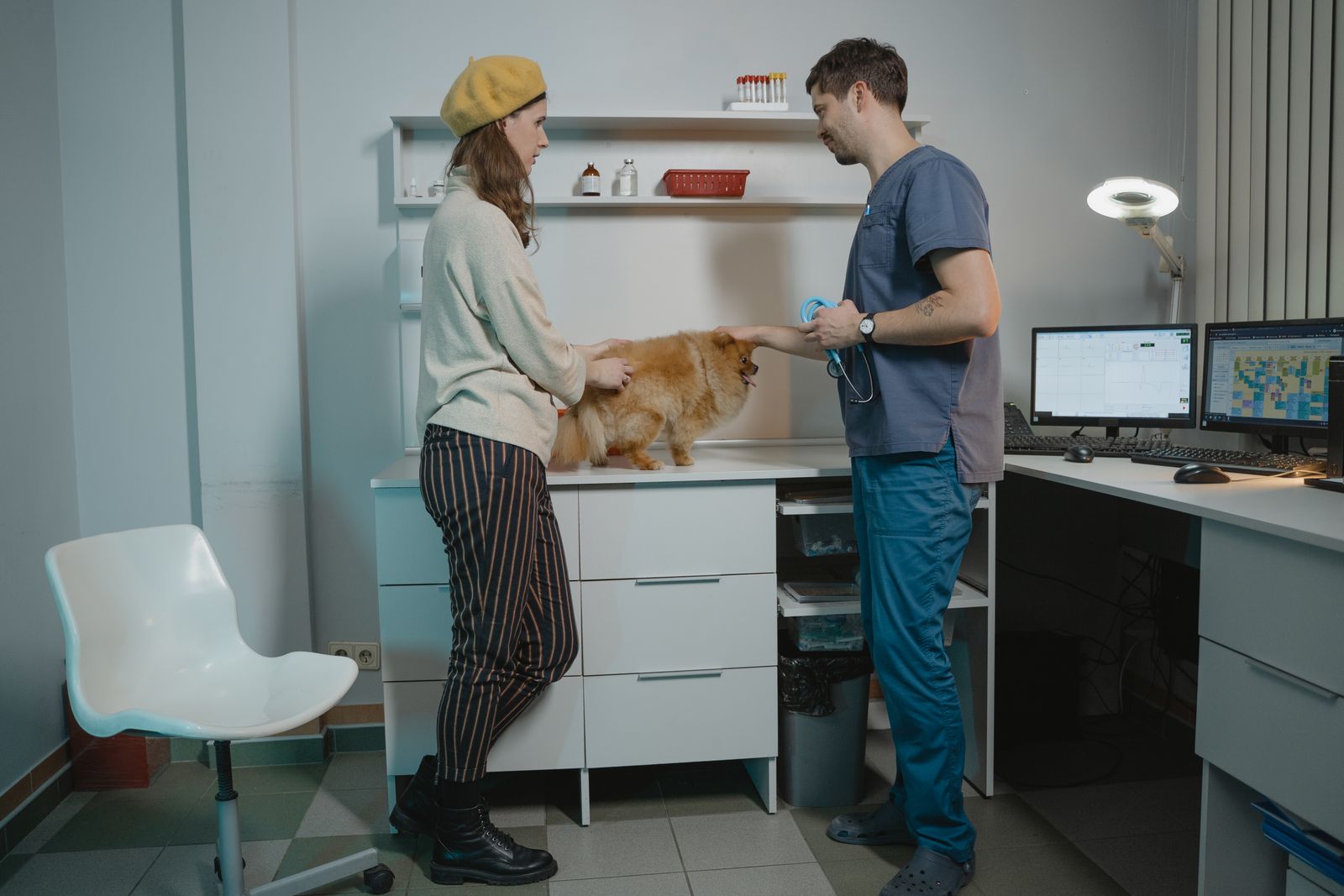
unday night, just before ten. Your dog has been limping since the afternoon, now he refuses to put any weight on the leg at all, and the only practice that picks up the phone is forty minutes away. You drive. The team is kind and quick, someone takes you straight through to the back, and at some point later you are standing at the counter with a sedated dog in your arms and a slip of paper in your hand, showing a number you were not expecting when you woke up that morning.
This is the moment dog insurance exists for. Three products will be offered to you, and they differ enormously in how useful they are. So you know where you stand: we do not sell insurance, we link to no tariffs, and we earn nothing from whatever you decide after reading this. What follows are the rules and the numbers behind them. This article does not replace individual insurance advice.
The order matters more than it sounds. If money is tight, take out the liability policy first and put the rest aside. If you can carry both, decide calmly afterwards between surgery cover and a comprehensive health policy.
The reason sits in the German Civil Code. Under Section 833 BGB, the keeper is liable if their animal injures a person or damages property. What makes it unusual is that this is strict liability. You are liable even if you did everything right, even if the lead held, the recall worked and your dog was simply being a dog. The exemption in the second sentence applies only to animals that serve the keeper's profession or livelihood. The family dog does not fall under it.
And that liability has no ceiling. A scratched car door is annoying; a cyclist who falls because of your dog and can no longer work is a different order of magnitude, because loss of earnings and treatment costs come on top, possibly for years.
Dogs and horses are excluded from private liability insurance in Germany. Cats, rabbits, birds and other tame small animals are included, dogs are not. The German consumer advice centres point this out explicitly. Anyone who assumes they are already covered through an existing contract is left with nothing when a claim arrives.
This protection is not expensive. The consumer advice centres quote an entry price from around 50 euros a year and still recommend a cover limit of at least five million euros. Going from one million to five usually costs a few euros a year, because damage on that scale is rare. When it happens, it is ruinous.
What matters in a comparison is the policy wording rather than the price. These points should be in it:
Two points only become obvious later. Cover abroad is often time limited, many contracts pay only for a few weeks at a stretch, which gets tight on longer trips through Europe with a dog. And puppies are included free in the first year with some providers, but not with others.

Dog keeping is regulated by the federal states, so there is no nationwide rule. In seven states every dog must be insured, regardless of breed or size. In the others the duty applies only to dogs classified as dangerous, or from a certain size: in North Rhine-Westphalia, for example, from 40 centimetres at the withers or 20 kilograms.
| Federal state | Insurance duty | Minimum cover under state law |
|---|---|---|
| Berlin | all dogs | 1 million euros per claim, deductible no higher than 500 euros per year |
| Bremen | all dogs | 500,000 euros personal injury and 250,000 euros property damage |
| Hamburg | all dogs | 1 million euros personal injury |
| Lower Saxony | all dogs | 500,000 euros personal injury and 250,000 euros property damage |
| Saxony-Anhalt | all dogs | 1 million euros for personal injury and property damage, policy no later than three months after the dog's birth |
| Thuringia | all dogs | 500,000 euros personal injury and 250,000 euros property damage |
| Schleswig-Holstein | expected for all dogs older than three months, binding for dangerous dogs | 500,000 euros personal injury and 250,000 euros property damage |
| Other states | only for dangerous dogs, in some cases from a certain size or weight | depends on state law |
Bremen is the example of a rule that changed recently, and of a mistake that keeps circulating online. Numerous comparison sites write that Bremen joined the list on 1 July 2026. What is correct: the new Bremen dog act has applied since 10 July 2025 and has required liability insurance for all dogs ever since, whereas the old law demanded it only for dangerous dogs. What arrived on 1 July 2026 was something else, the proof of competence: anyone acquiring a dog in Bremen since then takes the theory part before the dog moves in and the practical part within a year.
State law changes, and it changes without announcement. If you move house or a dog moves in, a look at your state's dog act or a call to the local authority is quicker than any argument about who was right last time.
Prices in German veterinary practices are not invented on the spot, they follow the fee schedule for veterinarians, known as the GOT. It sets a single base rate for every service, and the practice bills within a range of it.
In normal hours the rate runs from one to three times the base fee, in emergency service from two to four times plus a 50 euro emergency fee. Emergency service under the regulation means daily from 18:00 to 08:00, continuously from Friday 18:00 until Monday 08:00, and public holidays around the clock. The emergency fee may only be charged once per case, even if several animals belonging to the same owner need treatment. The 50 euros are a net amount, VAT is added on the invoice.
That explains the number at the counter from the opening scene almost by itself. The same examination that costs around 24 euros on a Tuesday morning comes to about 71 euros at three times the rate, and on a Sunday evening the emergency fee lands on top. None of this is a rip off, it is the regulation.
For larger procedures, real invoices help more than vague ranges. Stiftung Warentest, the German consumer testing foundation, calculated its test using three actual vet bills:
| Procedure | Invoice total |
|---|---|
| Intervertebral disc surgery | 5,041 euros |
| Cruciate ligament surgery | 3,803 euros |
| Spaying with removal of uterus and ovaries | 1,960 euros |
Then there is everyday life. In a survey by Skopos for the German pet trade associations IVH and ZZF, 57 percent of dog owners said they spent between 100 and 1,000 euros a year at the vet, and for 45 percent the visits came to between 100 and 500 euros. Running costs are therefore predictable for most people. The problem is the outlier: a gastric torsion, a road accident, a foreign body in the gut. Those cases arrive at night, they arrive without warning, and within a few hours they cost more than an entire dog year.
The GOT itself is currently under review, incidentally. The responsible federal ministry started an evaluation in 2025 and results are expected for the end of 2026. What will come out of it cannot be predicted seriously today.
Both pay vet costs, but they draw the line in completely different places.
| Surgery insurance | Comprehensive health insurance | |
|---|---|---|
| Pays for | operations including pre and post treatment | additionally outpatient treatment, diagnostics, medication, clinic stays |
| Premium | considerably cheaper | several times as much, depending on breed and age |
| Suits | a tight budget that only needs the worst case cushioned | chronically ill dogs or breeds prone to illness, predictable total costs |
| Typical gap | anything treated without surgery, such as allergies or physiotherapy | preventive care, neutering without medical need, care products |
For surgery insurance there are solid figures. In spring 2025 Stiftung Warentest examined 121 tariff variants from 25 providers against 60 criteria. The result: only one in four was recommendable. Very good offers cost between 216 and 403 euros a year, with the breed making a clear difference. For a six month old Jack Russell premiums started at 236 euros, for a Labrador of the same age at 305 euros. For seven year old dogs the choice was already noticeably smaller. One detail worth keeping straight, because it is often quoted wrongly: the test covered surgery tariffs, not comprehensive policies.
The market is growing fast. According to the German Insurance Association, around 845,000 pets had health cover in 2019 and more than two million in 2024; premium income rose over the same period from 173 to 720 million euros. The mix is shifting too: the share of comprehensively insured animals climbed from just under 22 percent in 2020 to almost 40 percent in 2024. Measured against roughly ten million dogs in German households, the large majority still has no cover at all.
This is where it is decided whether your contract holds up when it counts. The following points appear in almost every set of terms, just not on the offer page.
Up to this point it is about signing up. The next three points concern the years afterwards, and they are the reason some owners find themselves staring at a letter from their insurer years later.
The logic behind it is the uncomfortable part. A contract taken out young and healthy is cheapest in the years when you need it least. It gets expensive and shaky in the years when you really need it. That is not a scandal, it is how the product is built. You just want to know it before you sign.
Four search terms in the PDF tell you more than any marketing page. Open the policy conditions and search one after another for "Wartezeit" (waiting period), "Höchstsatz" or "GOT" (maximum rate), "Kündigung" (cancellation) and "ausgeschlossen" (excluded). Those four hits answer when your cover starts, up to which fee rate the insurer pays, who may end the contract and what is never reimbursed. Everything else is packaging.
Insurance is not a savings account, it is a trade: a small certain loss against a large uncertain one. Anyone with enough reserves can skip that trade. The calculation just has to be honest.
Say you put aside 30 euros a month instead of paying a premium. After one year you have 360 euros, after five years 1,800 euros. The cruciate ligament operation from the Warentest sample cost 3,803 euros. So it takes a good ten years before your pot carries it, and accidents do not respect savings plans. The other way round: anyone who can free up 4,000 or 5,000 euros at any time, without the rest of their life wobbling, does not need the insurance in economic terms.
In between lies the route many people take: surgery insurance for the rare large amounts, plus a small monthly amount for vaccinations, dental work and the many small items no policy reimburses. That covers both ends, the expensive one and the frequent one.
If the dog has not moved in yet, this calculation belongs in the planning, right next to food, dog tax and care. Anyone still asking which dog suits them should also know that large breeds cost more to insure on average and that some breeding lines carry known problems.
There is a route between shrugging and hiring a lawyer, and surprisingly few owners know it. The Versicherungsombudsmann is the recognised arbitration body for the German insurance industry. The procedure is free for consumers, works without legal representation and can be run digitally. Up to a value in dispute of 10,000 euros the decision is binding on the insurance company, up to 100,000 euros the ombudswoman issues a recommendation.
That there is demand for it shows in the 2025 annual report: pet health insurance accounted for 657 admissible complaints, once again an increase of more than a hundred. The disputed topics read like a summary of this article: which vet costs the insurer has to reimburse, whether an exclusion applies, particularly often for neutering and spaying, and whether cancellations and premium increases were valid.

Insurance is not a subject that brings joy. It belongs to the things you sort out on a quiet evening so they are already settled on a restless one. Liability cover is not negotiable. Everything else hangs on a single question: how much money could you raise on a Sunday night without something else wobbling afterwards?
Answer that honestly once and the hard part is behind you. The rest is four search terms in a PDF. What the practice will want from you in the middle of the night, weight, medication, diagnoses, vaccination status, is already together in Souldog, including the emergency pass for when things need to move fast. For more background on prevention and common conditions, see our overview of dog health.
And your dog? He notices none of it. He is asleep.
 Souldog