The front of the bag shows a happy chicken, the back says "meat and animal derivatives". Here is what sits between those two claims and which numbers you can actually compare.
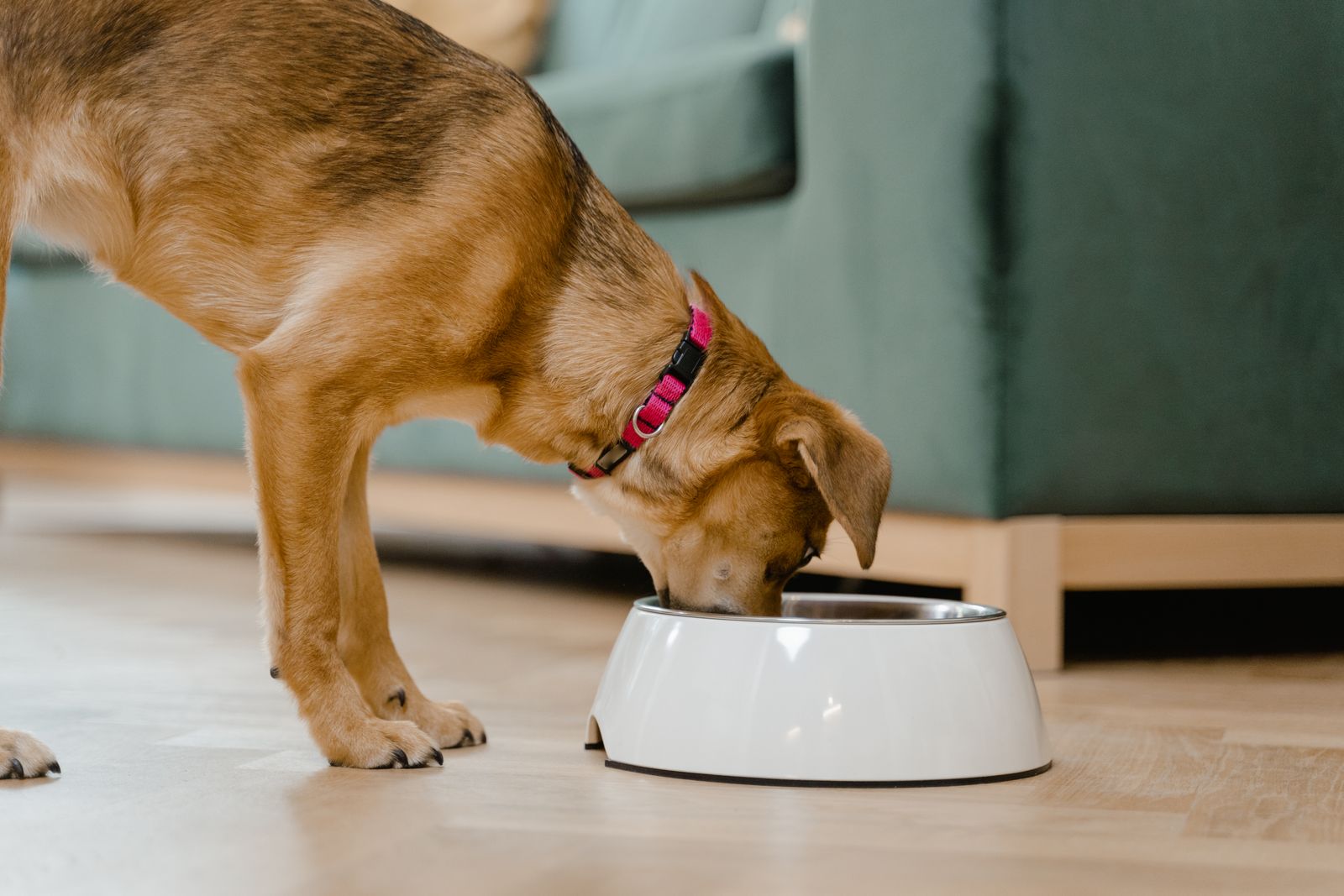
ou are standing at the shelf. On the left, a bag with a radiant chicken. On the right, one with a meadow and the word "natural". Both cost about the same, both promise the best. You turn the first bag over, and on the back, in very small print, it says something about "crude ash". Your dog, meanwhile, has already made a decision: the bag that rustles the loudest.
Four things matter on a dog food label: the composition (ingredients in descending order by weight), the analytical constituents (crude protein, crude fat, crude fibre, crude ash), the statement "complete feed" and the feeding guidelines. You can only compare wet and dry food once you convert the values to dry matter. Names and numbers on the front have fixed minimum percentages, while words like "natural" or "premium" say little on their own.
A label shows you a lot, but not everything. That is why the end of this article also covers what you will not find there.
In the EU, Regulation (EC) No 767/2009 does most of the work of deciding what has to appear on dog food: animal species, intended use, composition, analytical constituents, additives, shelf life and manufacturer. That applies in Germany just as in Austria or France. The statements you may know from American guides (such as the AAFCO line "complete and balanced") are not part of it. Different rules apply there.
On a bag of dog food you will usually find these blocks:
| Label block | What is behind it | Mandatory? |
|---|---|---|
| Type of feed | "Complete feed" or "complementary feed" for dogs | Yes |
| Composition | Ingredients, in descending order by weight | Yes |
| Analytical constituents | Crude protein, crude fat, crude fibre, crude ash, moisture | Yes (moisture only above 14 %) |
| Additives | Vitamins, trace elements, preservatives, colourants, flavourings | Yes, partly with amounts |
| Feeding guidelines | Daily amount by weight | Yes, as directions for use |
| Energy content | kcal or kJ per 100 g | Voluntary |
Manufacturer, best-before date and net weight come on top. One block deserves more attention than it usually gets: the type of feed.
A complete feed covers your dog's daily needs on its own, a complementary feed only together with other food. That is how Regulation 767/2009 defines it: a complete feed is sufficient for a daily ration by reason of its composition, while a complementary feed has a high content of certain substances and is only sufficient for a daily ration when combined with other feed.
In practice: if the can only says "complementary feed", it is not a replacement for a main meal, even if the contents look like dinner. This applies to some wet foods with a very high meat content, for example, as well as chews and treats. Feeding only these risks gaps in minerals and vitamins.
Whether a complete feed really is complete cannot be seen from the label alone. The industry follows the nutrient recommendations of the European federation FEDIAF; whether a manufacturer meets them is something you can ask the manufacturer. WSAVA advises asking the manufacturer directly: whether a qualified nutrition expert develops the recipes, what quality controls exist and whether studies have been published.
Ingredients are listed in descending order by weight, calculated on the moisture content in the feed, which means with their water weight. The first ingredient is the heaviest, the last the lightest. That sounds fair, but there is a catch.
Fresh meat is largely water. Much of it is lost during baking or extrusion. If "chicken" comes first, the finished dry food can still contain more grain or dried meat meal than the order suggests. That is not a trick, just arithmetic. It only means that the order is a hint, not a quality seal.
Two forms of declaration are allowed:
Both forms are legal. The industry code advises against mixing them, unless one ingredient is highlighted. The open declaration tells you more, while the closed one gives the manufacturer room to adjust the recipe without changing the packaging. That is a disadvantage for you as a reader, but not automatically a sign of bad food.
If a manufacturer highlights an ingredient in words, pictures or graphics, for example with a chicken picture, the composition has to name that ingredient with its percentage. That is what the code the industry relies on says.
The analytical constituents are laboratory measurements, not ingredients. For complete dog food, crude protein, crude fat, crude fibre and crude ash are mandatory. Moisture is added as soon as it is above 14 %. That is why it almost always appears on wet food labels and often does not on dry food.
Crude protein is calculated from the nitrogen content. The value says nothing about how well your dog can use the protein; muscle meat and tendons look the same here. Crude fat provides a lot of energy. A high value is not automatically bad, but it counts towards the calorie balance. Crude fibre is roughly the indigestible plant fraction and affects satiety and digestion. Crude ash is what remains when the food is burnt in the laboratory: the minerals, such as calcium, phosphorus and magnesium.
Crude ash is where most misunderstandings happen. It is not added as filler, it is measured. Every food has some, because every ingredient contains minerals. A conspicuously high value can point to a high bone content or lots of added minerals. Many guides use as a rough rule of thumb that ash in the dry matter should be below about 10 %. That is not a legal or veterinary limit, and for certain recipes a different figure can make sense. A high number alone is a reason to ask questions, not a verdict.
What is often missing is the carbohydrate content. It is not on the label. You can estimate it roughly by subtracting all values (including moisture) from 100. The remainder is called "nitrogen-free extract" and consists mainly of starch and sugar.
You can only compare wet and dry food on a dry matter basis: dry matter in percent is 100 minus moisture, and every nutrient value is divided by that dry matter. All values on the label refer to the food as it sits in the bowl. A can with 78 % water therefore looks low in protein at first glance.
An example with invented but realistic numbers:
| Item | Dry food | Wet food |
|---|---|---|
| Crude protein on the label | 26 % | 8 % |
| Moisture | 10 % (assumed) | 78 % |
| Dry matter | 90 % | 22 % |
| Crude protein in dry matter | 26 ÷ 0.90 = 28.9 % | 8 ÷ 0.22 = 36.4 % |
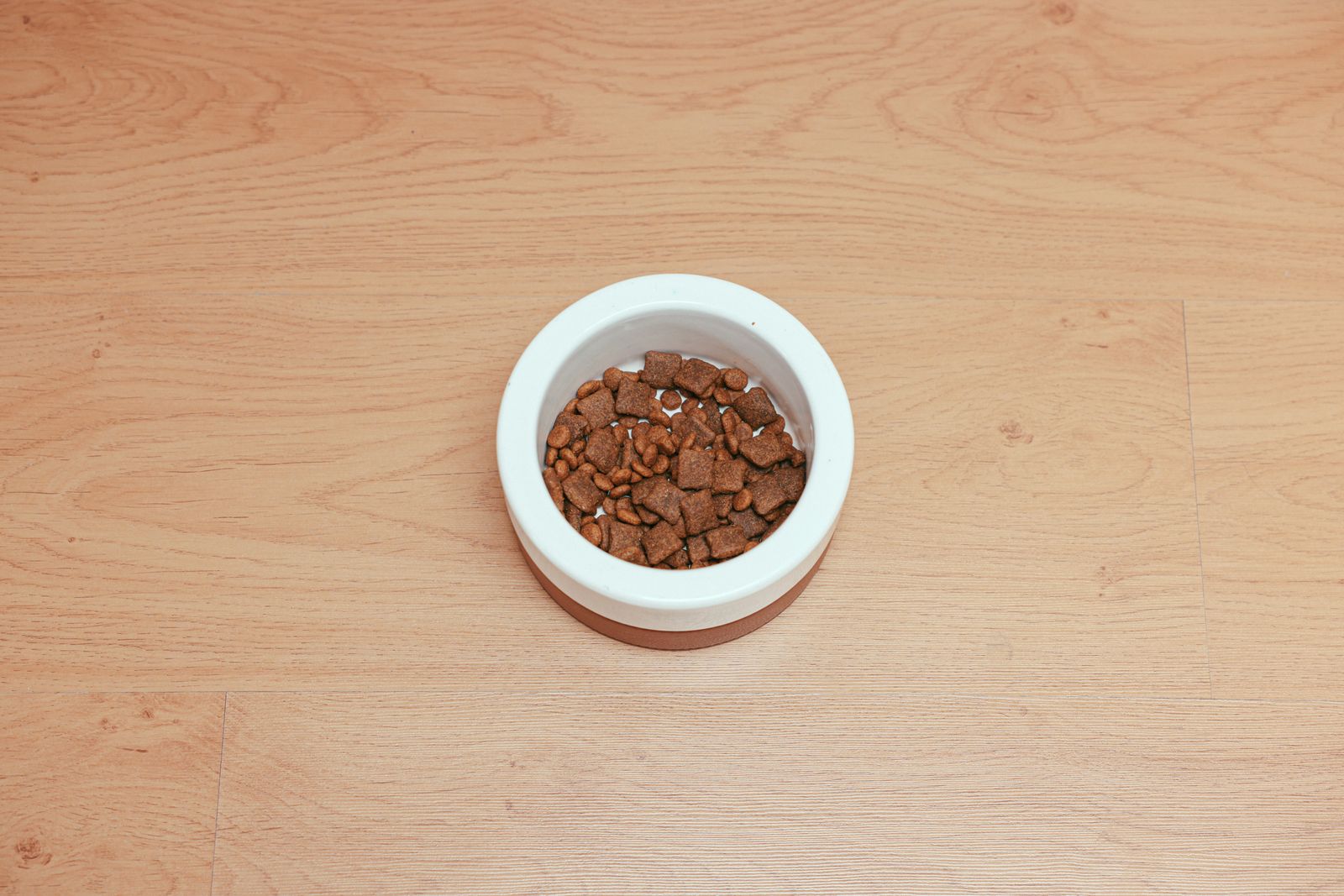
So in dry matter, the wet food has more protein, even though it looks lower on the label. The same goes for fat and ash. If there is no moisture value on dry food, it is at most 14 %. For a rough calculation you can work with 10 % or ask the manufacturer.
The comparison only tells you about concentration, not about the amount in the bowl. Because wet food contains so much water, your dog gets more grams per meal but less energy per gram. For the portion, energy is what counts. How to work it out is in our article on how much to feed your dog.
The name of a dog food tells you the minimum share of the named ingredient: "with chicken" means at least 4 %, "rich in chicken" at least 14 %, and "chicken" or "chicken menu" at least 26 %. These thresholds come from the FEDIAF Code of Good Labelling Practice, which EU authorities have validated and which manufacturers apply alongside the law. It is an industry guideline, not statute.
| The pack says | Minimum share of the ingredient | Example |
|---|---|---|
| "Chicken flavour" | 0 %, flavouring only | The flavouring is listed under additives |
| "Flavoured with chicken" | more than 0 but under 4 % | Traces for taste |
| "With chicken" | at least 4 % | one twenty-fifth of the food |
| "Rich in chicken", "extra chicken" | at least 14 % | a good seventh |
| "Brand chicken", "chicken menu", "chicken dinner" | at least 26 % | a good quarter |
| "Only chicken", "all chicken" | only this ingredient, plus permitted additives, minerals and processing water | for example, a can with just chicken |
Two things easily get lost in everyday shopping. First, "chicken" refers to all feed materials from the chicken, so also liver and heart, not just muscle meat. The code defines "meat" narrowly as skeletal muscle, but the category "meat and animal derivatives" is broad. Second, the percentages say nothing about what the rest is. "With chicken" plus 96 % other ingredients is allowed if the 4 % are correct.
Animal by-products are parts of slaughtered animals that are less in demand on the human market, such as liver, heart, lungs, kidney and tripe. According to the European category catalogue, "meat and animal derivatives" covers all the fleshy parts of slaughtered warm-blooded land animals and all products arising from processing the carcase.
The term has a bad reputation that it only partly deserves. Offal is nutrient-dense; liver, for example, supplies vitamin A and iron, and many dogs love it. Pet food may only be made from material in category 3 of Regulation 1069/2009, meaning from animals without signs of communicable disease. Using good parts instead of throwing them away is also a sensible thing.
The flip side: with a closed declaration you cannot tell which parts exactly are in there. The range goes from liver to less sought-after parts. If you want to know more, ask the manufacturer.
You should not rely on marketing terms, because most of them have no fixed legal meaning for quality. Some are partly regulated anyway.
The FEDIAF code allows "natural" only for substances to which nothing has been added and which have been processed only physically, for example dried, frozen or ground. There are separate wordings for added vitamins and minerals, such as "made with natural ingredients, with added vitamins and minerals". That is an industry guideline, not a quality promise. "Fresh" is just as narrowly framed: according to the code, cooked, dried or frozen meat may not be called "fresh".
"Human grade" comes from the USA. In the EU it is not a defined labelling term, and it does not appear in the FEDIAF code. What it is supposed to mean is up to the manufacturer. "Premium", "super premium" and "holistic" are likewise not legally defined quality levels.
"Grain-free" says that no grain is included. It does not say whether the food is better tolerated or healthier. Substitutes such as potato, peas or lentils are not automatically higher quality.
In the USA, the FDA investigated a possible link between grain-free food and heart disease (dilated cardiomyopathy, DCM). In December 2022 the agency stated that case numbers alone do not establish a causal relationship, and it stopped its regular updates. As things stand, the cause is not settled, and experts assume several contributing factors. If your dog eats grain-free food or you want to switch, talk to your vet practice. No panic switch is needed, but a consultation is.
This check tells you in two minutes whether a food suits your dog and your standards.
| What you check | What you see | What it means |
|---|---|---|
| Type of feed | "Complete feed for dogs" | Suffices as a main meal; "complementary feed" does not |
| Life stage | Puppy, adult, senior, breed or size | Does the target group note fit your dog? |
| Ingredient format | Open or closed declaration | Open shows more, closed is legal but less transparent |
| First ingredients | Type of meat, grain, fat | Water distorts the order, a hint, not a verdict |
| Product name | "with", "rich in", no addition | Minimum shares of 4 %, 14 %, 26 % |
| Analytical constituents | Protein, fat, fibre, ash, moisture | Convert to dry matter when comparing wet and dry |
| Additives | Vitamins, preservatives, colourants | Preservatives and colourants name only the functional group |
| Energy content | kcal per 100 g, if given | Basis for the portion, see feeding amount |
| Feeding guidelines | Daily amount by weight | A guide that you adjust to body shape and activity |
On additives: many of them make sense, such as vitamins and trace elements, so that a complete feed is actually complete. Every additive has to be authorised in the EU. For colourants and preservatives, often only the name of the group appears; the exact designation is given by the manufacturer on request.
The label says nothing about digestibility, origin of the ingredients, protein quality or how your dog tolerates the food. It shows what is in there, not what your dog makes of it.
Three examples: two foods with identical crude protein can be used very differently. Whether the ingredients come from nearby or travelled far is not compulsory on the pack. And whether your dog gets diarrhoea depends on its digestive tract, not on your label-reading skills.
The best label is therefore the dog itself: stool, coat, energy, body shape. If your dog gains or loses a striking amount of weight, eats poorly or does not tolerate a food, that is a matter for the vet practice, not for the small print. With a fussy dog, by the way, the cause often has nothing to do with the food. If you prefer to put the meals together yourself, the basics of raw feeding cover the key rules. And if you wonder what else belongs in the bowl or on the floor, our overview what dogs can eat helps. Puppies have their own requirements, which feeding puppies explains.
Souldog can help you evaluate a label faster. In the food scanner you photograph the label or scan the barcode, and the app reads out the composition and evaluates it. The food calculator uses your dog's weight, age and activity to work out a daily amount. Neither replaces advice from your vet practice, and an assessment from the app is not a diagnosis.
Once you have read the numbers on the label and know what they say, the next step is usually smaller than it looks: choose a food for your dog, work out the amount, observe. The rest is routine. And routine is something your dog is a world champion at anyway, at the latest when 6 pm strikes.
 Souldog