Your puppy has moved in, the bowl is ready, and suddenly you have a thousand questions. How often, how much, what food? Here you'll get the answers step by step, plus the one safety point many guides leave out.
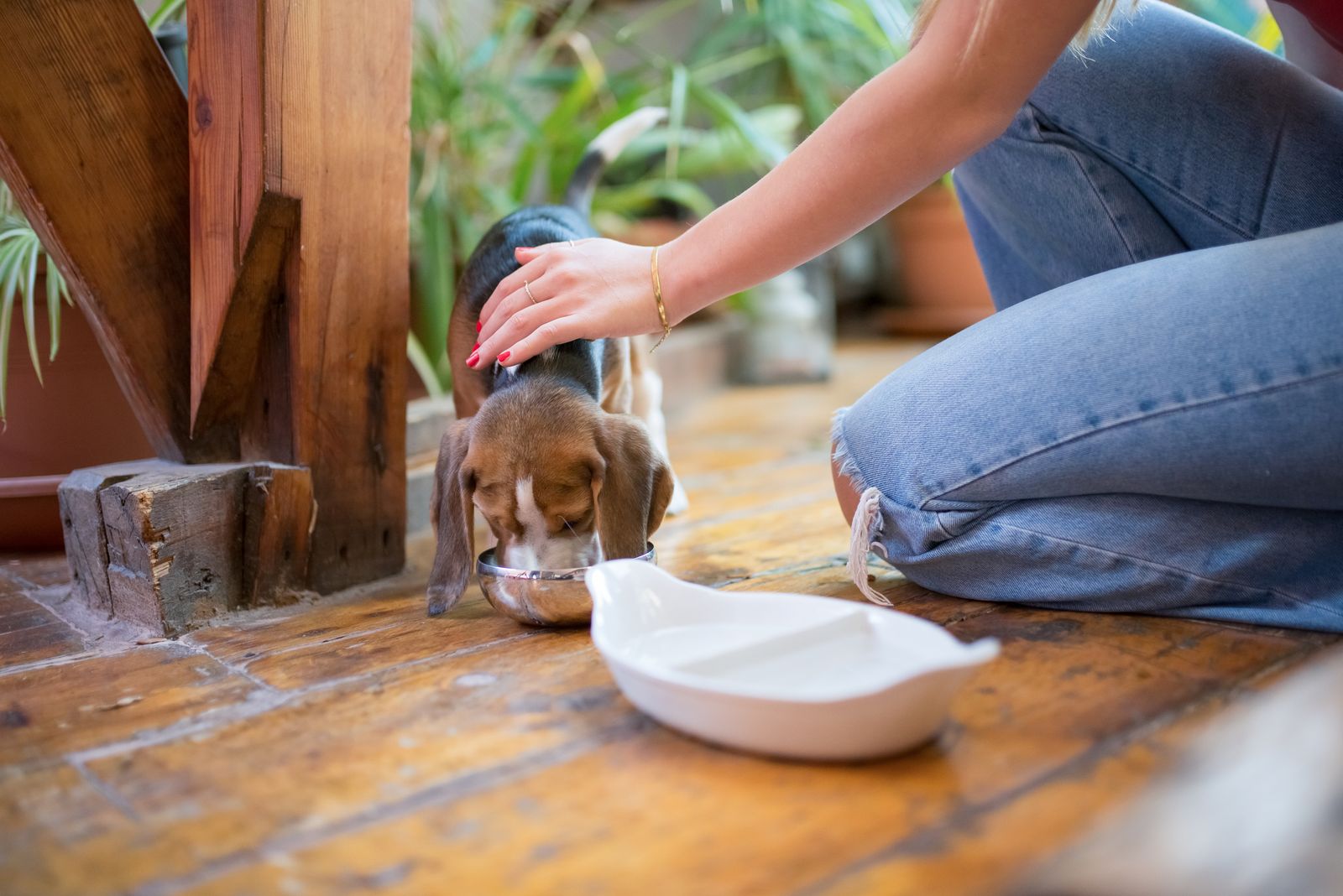
The first bowl in a new home is a small drama in three acts. First the puppy sniffs it suspiciously, then he looks at you as if you'd played a trick on him, and in the third act the food disappears in record time anyway, usually half of it ending up on the floor too. You stand there wondering: was that too much? Too little? The right amount?
uppy feeding feels, in the first few weeks, like a test nobody handed you the material for. Yet most of it comes down to a handful of clear rules. And there's exactly one point where mistakes get genuinely costly, especially if you're raising a large dog. We won't save that for the end, we'll walk through it calmly right away.
A puppy's stomach is small, but the energy needs of growth are huge. That's why you split the food across several small meals instead of one or two big ones. As your puppy gets older, the number of meals can drop, because the stomach grows and portions can get bigger.
| Puppy's age | Meals per day |
|---|---|
| up to about 3 months | 4 |
| about 3 to 6 months | 3 |
| from about 6 months | 2 |
| Toy and very small breeds, first months | 4 to 6 |
These age ranges are guidelines, not fixed dates. Some puppies switch to three meals earlier, others need four for longer. Fixed feeding times help in two ways: they make digestion predictable and make housetraining easier, because regular meals lead to regular, predictable trips outside.
One point deserves special emphasis, because many guides skip over it: very small breeds like Chihuahuas, Yorkshire Terriers, or Toy Poodles should eat especially often in their first months of life, four to six times a day is fine. Their tiny bodies have a harder time keeping blood sugar stable, and too long a gap between meals can become dangerous. More on this below, in the warning signs section.
There are rules of thumb for calorie needs, for instance that a puppy under four months old needs roughly three times its resting energy requirement, and about twice that afterward. But these are too rough for everyday use, because needs vary a lot with breed, activity level, and growth stage. It's better to use the manufacturer's feeding chart as your starting point and adjust based on body condition.
Adjusting portions works differently than with an adult dog: the classic Body Condition Score was designed for fully grown animals. With a growing puppy, it's better to track development over the weeks, meaning regular weigh-ins and a realistic look at body condition. The key message behind this might be the most important one in this whole article, and it comes from a study that ran for more than fourteen years: dogs kept lean throughout their lives lived, on average, almost two years longer and needed treatment for arthritis significantly later. A chubby puppy isn't a sign of good care, it's the foundation for joint problems later on.
Now for the point that matters more than all the others. If your puppy is going to grow into a large dog, meaning over about 25 kg, stricter rules apply, and the reason is his skeleton.
Never add extra calcium, bone meal, or large amounts of dairy to a complete puppy food. In the first months of life, puppies can't regulate how much calcium they absorb from the gut. Excess calcium gets deposited and disrupts controlled bone growth. The result can be permanent skeletal damage, ranging from osteochondrosis to growth disorders to joint deformities. A good complete food already covers the requirement fully.
Large breed puppies need a special large breed food that deliberately limits calcium and energy. The calcium content in these foods sits in a controlled range, usually around 0.8 to 1.2 percent of dry matter, with a calcium-to-phosphorus ratio of about 1.1 to 1.4 to 1. You don't need to calculate these numbers yourself, a large breed puppy food labeled as complete takes care of that for you. What matters is this: with a food like this, any extra source of calcium isn't a bonus, it's a risk.
Almost as important as calcium is the total amount of food. The strongest lever for a healthy skeleton in large breeds is not letting the puppy grow too fast. Too many calories speed up growth and raise the risk of hip and elbow problems, regardless of the dog's eventual adult weight. That's why large puppies should be fed measured portions, with the bowl not left full all day. Small and medium breeds are less sensitive to this, but they also benefit from measured meals.
Nutritionally speaking, growth is the most demanding phase of a dog's life. In just a few months, a puppy builds bone, muscle, and organs, and for that he doesn't just need more food, he needs a different balance of nutrients than an adult dog. That's exactly what a complete puppy or all-life-stages food provides. A plain adult food isn't formulated for these increased needs.
This is also why home-cooked or raw meals are especially tricky for puppies. Without a professionally calculated recipe, it's easy to end up with too much or too little of key nutrients, and during growth, mistakes with calcium and phosphorus in particular can have serious consequences. If you want to put together your puppy's food yourself, do it only with a ration calculated by a veterinary professional. You'll find the basics and pitfalls in the article BARF for Dogs: An Honest Look at the Basics.
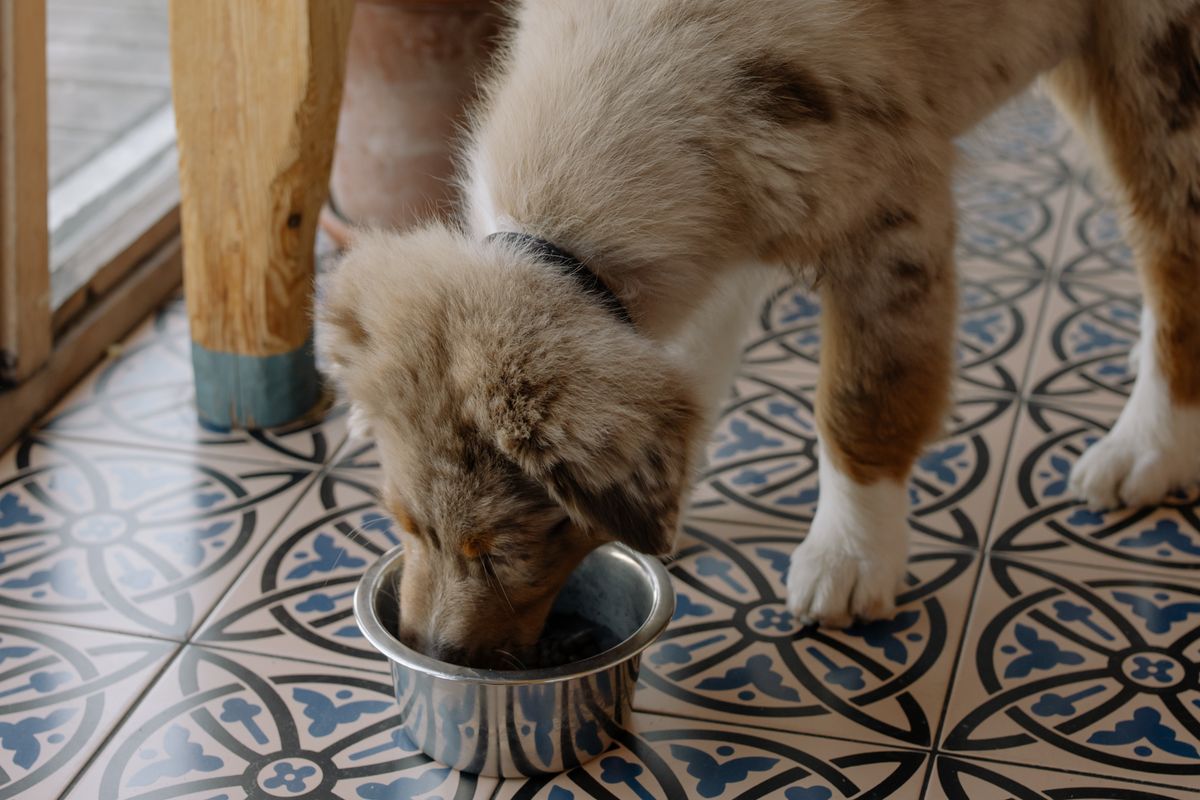
The switch to adult food isn't based on the calendar, but on when bone growth is finished. And that depends heavily on size: a small dog is fully grown early, while a giant breed takes much longer.
| Breed size | Switch at about |
|---|---|
| Small and toy breeds | 9 to 10 months |
| Medium breeds | 12 months |
| Large breeds | 12 to 18 months |
| Giant breeds | 18 to 24 months |
Don't be fooled if a large-breed puppy already looks huge at six months old. Size isn't the same as finished growth, his skeleton often keeps maturing for a long time after that. If you're not sure, your vet can give you the clearest answer on when to switch. And by the way, the switch itself should be just as gradual as any other food change, you'll find out how in the next section.
A few stubborn pieces of advice circulate around puppy feeding that are well meant but outdated or even risky. The most dangerous one is about calcium for strong bones: with a complete puppy food, adding calcium isn't helpful, it's risky, especially for large breeds, because the requirement is already covered. The "more is better" mindset falls into the same trap. A chubby puppy grows too fast, and that strains the joints. Lean is the safe choice, not stingy, but not generous either.
Other classics come from the kitchen. Raw egg for a shiny coat tends to backfire, because raw egg white binds biotin, so if you give egg, cook it first. And a little bowl of milk isn't a good idea either, since after the nursing period most puppies digest milk sugar poorly, which leads to soft stool. Water is the only drink a puppy needs.
That leaves two misconceptions about how and when. A permanently full bowl, meaning free feeding, drives especially large breeds to grow too fast; measured meals are safer and also make the dog more cooperative. And a puppy's size tempts owners into switching to adult food too soon. Looking big isn't the same as being fully grown, so you stick with puppy food until growth is truly finished.
Most feeding questions are harmless. A few situations aren't, and with a young puppy, every hour counts.
Low blood sugar in small puppies is an emergency. Trembling, weakness, listlessness, a wobbly gait, or even seizures or unconsciousness can point to low blood sugar in toy and very small breeds. If the puppy can still swallow, rub a bit of glucose or sugar water onto the gums and get to the vet immediately. Equally urgent: bloody, foul-smelling diarrhea together with vomiting and severe weakness in a young puppy who isn't fully vaccinated yet. This can point to parvovirus, which is life-threatening if left untreated.
Even outside of emergencies: a puppy who skips one meal but is otherwise bright and active is usually nothing to worry about. But if he repeatedly eats poorly, seems listless, has ongoing diarrhea, or has a bloated belly on an otherwise thin body, get it checked out. A distended belly in a puppy can, for example, point to worms and should be examined by a vet.
The puppy phase is short, exhausting, and looking back, over far too quickly. When it comes to feeding, you don't need to become a nutrition scientist: a good puppy food, fixed mealtimes, a lean little body, and the one rule to remember that you never add extra calcium. With that, you've set the most important course.
If you want to keep track of it all, Souldog can help: in the app, you set up your puppy's profile, log his weight over the weeks, and see whether his development stays within a healthy range. And while you're still wondering if he's maybe a bit too thin, he's probably already outgrowing whatever collar you bought last week.
 Souldog