Two food bowls, a thousand opinions, and a range on the packaging wide enough to cover everything from lean to chunky. Here you'll calculate your dog's food portion the right way, step by step, and learn the check that beats any formula.
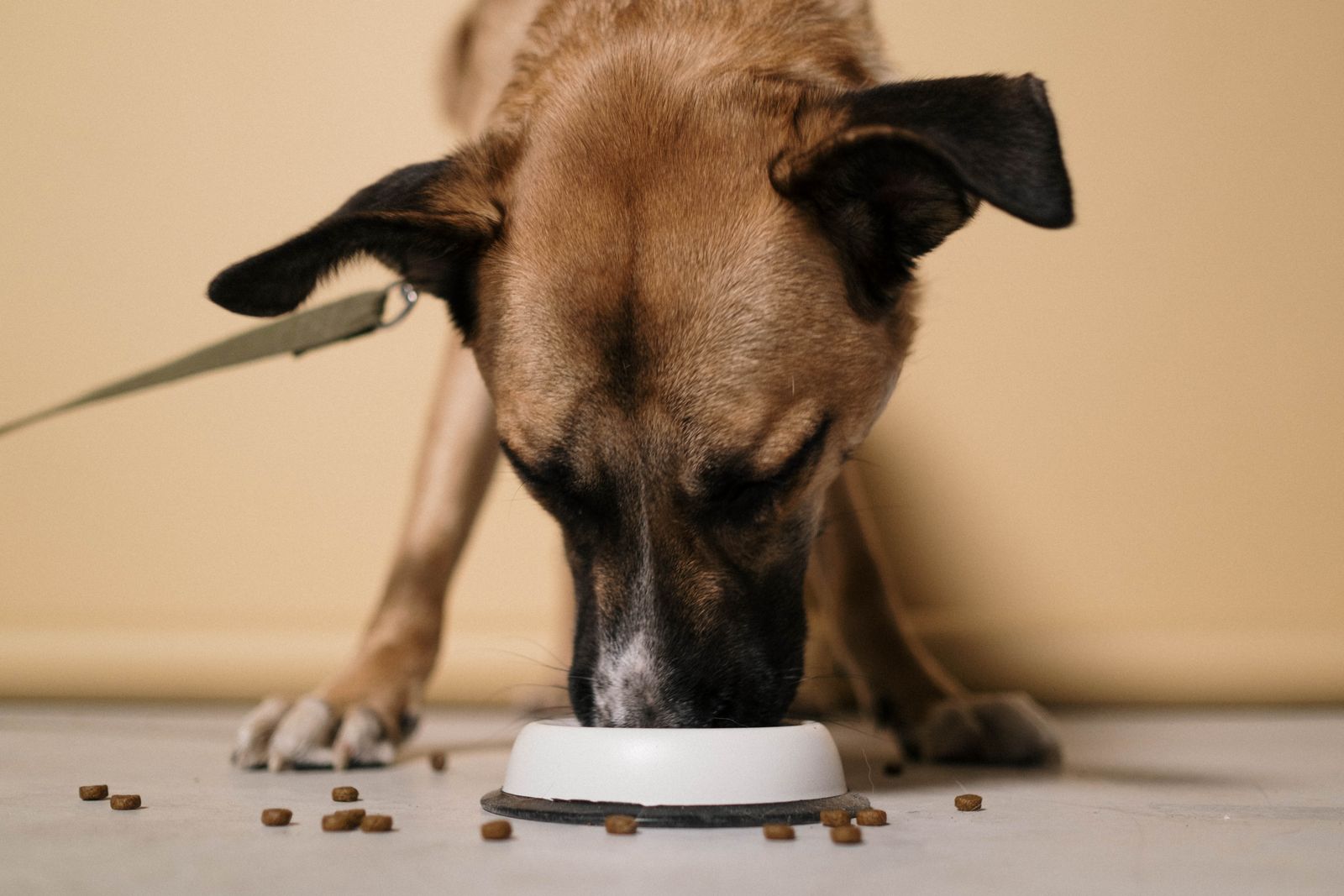
The bag of dry food promises you an answer, and then you read the fine print. "10 to 25 kg: 150 to 320 grams." Between those two numbers sits half a dog. So you stand in the kitchen with the measuring cup, guessing whether your four legged friend is closer to the upper or lower value, while he watches you as if he's known the answer all along and just refuses to tell you on principle.
he good news: there's a method more accurate than any gut feeling or range on the packaging. It takes a formula, a calculator, and a genuine five minutes. And after that comes the real trick, one that matters more than all the calculating.
Keep this sentence in mind as you keep reading: the formula gives you the starting point, your own eye on the dog gives you the correction. Let's start with what most guides recommend, and why it falls short.
Almost everywhere you look, you'll find the same quick rule: one to two percent of body weight in dry food, two to four percent in wet food. It's convenient, and for an average dog it lands roughly in the right range. The catch is in the biology: energy needs don't grow at the same rate as body weight.
Metabolism doesn't scale one to one with body mass, it scales roughly with mass to the power of 0.75. That sounds technical, but it means something very practical: a small dog burns more energy per kilogram of body weight than a large one. A five kilogram Miniature Pinscher needs noticeably more calories per kilogram than a 40 kilogram Great Dane. Anyone who sticks rigidly to a fixed percentage tends to overfeed the big dogs and underfeed the small ones. The energy formula captures exactly this curve, the percentage rule doesn't.
Then there's a second blind spot: a pure weight based rule has no idea whether your dog is neutered, whether he dozes on the sofa all day, or whether he's a young dog barreling through the woods. And those are exactly the factors that shift energy needs the most.
There's also a linear shortcut formula, RER = 30 × weight + 70, that works fine as mental math for medium sized dogs between about 3 and 20 kilograms. For very small and for large dogs, though, it deviates noticeably, so we're sticking with the more accurate power formula here.
To give you a feel for the scale, here are four neutered, adult dogs using the factor 1.6. The values are rounded and apply to a dog at a healthy weight as a starting point, not as a ration set in stone.
| Weight | Resting Requirement (RER) | Daily Need (× 1.6) | Dry Food (370 kcal/100 g) |
|---|---|---|---|
| 5 kg | about 234 kcal | about 375 kcal | about 100 g |
| 10 kg | about 394 kcal | about 630 kcal | about 170 g |
| 25 kg | about 783 kcal | about 1,250 kcal | about 340 g |
| 40 kg | about 1,113 kcal | about 1,780 kcal | about 480 g |
You can see the curve from earlier written out in numbers: the 40 kilogram dog weighs eight times as much as the five kilogram dog, but doesn't need eight times the food, only about five times as much. That's exactly the effect every simple percentage rule misses.
A word on neutering, since a lot of exaggeration circulates about it: energy needs actually drop by about a tenth after neutering, not by a third. The reason neutered dogs still gain weight so often is rarely the neutering alone, it's that the portion stays the same afterward while appetite goes up. Simply use the factor 1.6 instead of 1.8, and keep an eye on body condition.
Now comes the part that most guides leave out, even though it's the most important one. The neat formula above has a built in margin of uncertainty: actual energy needs between two dogs of the same weight can differ by up to 30 percent in either direction. One is a fuel efficient furnace, the other burns through everything. No calculation in the world can predict that for your specific dog. Your eyes and your hands can.
The Body Condition Score is the standard veterinarians use to assess body condition too. You don't need a degree for it, just a bit of practice. Run a flat hand over the rib cage: the ribs should feel like the back of your hand when you hold your fingers flat, easily felt under a thin layer but not visibly sticking out. Then look at your standing dog from above: behind the rib cage, the body should taper into a waist. And viewed from the side, the belly line behind the rib cage should rise up toward the rear, instead of running flat or even sagging.
If you can only feel the ribs under a thick layer of padding and can't find a waist at all, your dog is carrying too much weight, no matter what the scale says. If the ribs stick out visibly and the waist is very pronounced, he's too thin. You correct both through the amount you feed, not through the formula. The score is the feedback, the formula was only the first guess.
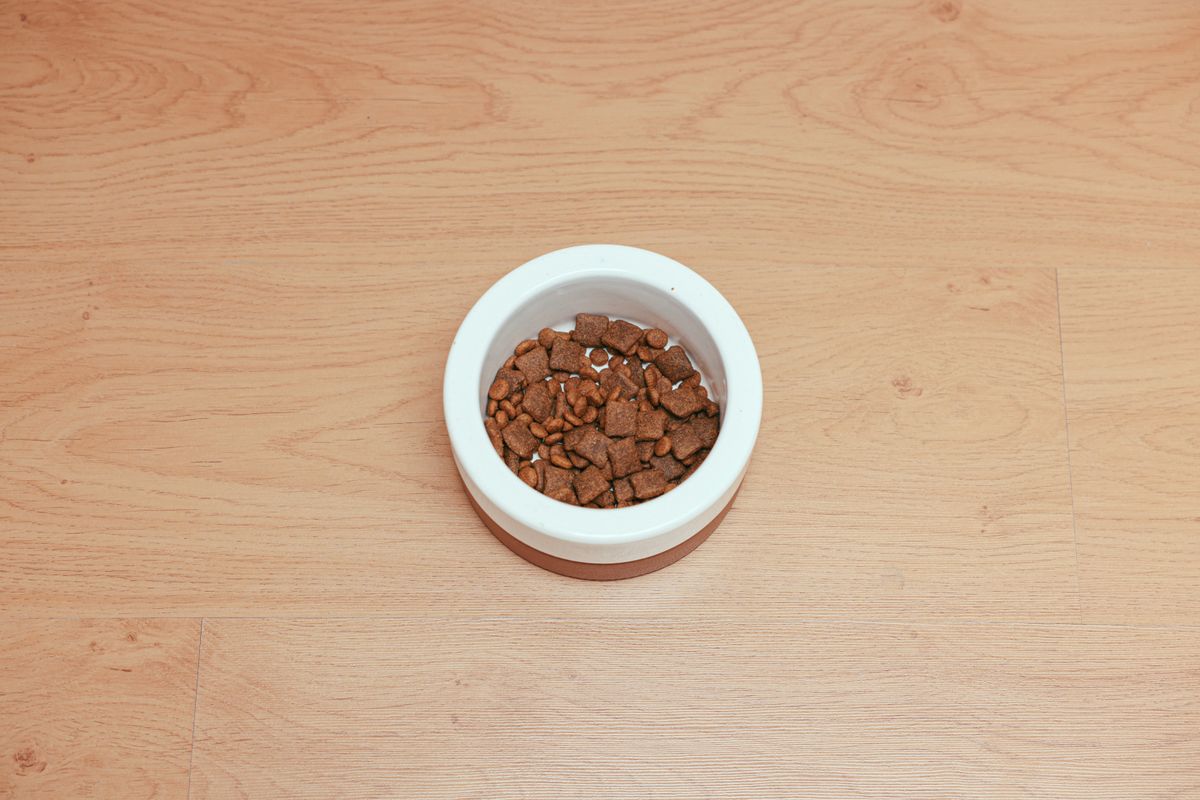
This is a good place to clear up a common piece of half knowledge. You often hear that the numbers on the food bag are deliberately set too high so the bag empties faster. For cat food, there's actually evidence for that. For dog food, the research looks different: an analysis of 200 dry foods concluded that feeding guidelines for dogs tend to be calculated conservatively and provide a reasonable starting point.
So the real problem with the package isn't that the numbers are inflated, it's how wide the range is. "150 to 320 grams" applies to an average dog in that weight class and completely ignores neutering status, activity level, and individual metabolism. So treat the package figure as a rough frame, and your own calculation plus the Body Condition Score as the fine tuning. If your calculated amount roughly matches the lower end of the package range, you're on the right track.
Two meals spread the calories comfortably across the day and keep the stomach neither empty too long nor overloaded. A single large meal has been part of the conversation ever since a large observational study found that dogs fed once a day scored somewhat better across several health categories. Important caveat: that's an association from a questionnaire study, not proof that feeding once a day makes dogs healthier. Owners who feed once a day may well differ in other ways from owners who feed twice.
For large, deep chested breeds, there's a solid counterargument: a single very large meal is classically considered a risk factor for gastric torsion, also called bloat, in these dogs. For them, several smaller portions remain the safer choice. For most dogs, in the end, the number of meals matters less than the total amount over the day.
This is where most of us miscalculate, and it goes unnoticed for a long time. The training treat, the evening chew stick, the bit of cheese used to hide a pill: all of that is calories, and it belongs inside the daily ration, not on top of it. The common rule of thumb: anything that isn't the actual complete food should make up no more than 10 percent of daily calories.
For a small dog, that limit is reached faster than you'd think. A daily need of 375 kilocalories leaves just under 40 kilocalories for extras, and a single chew bone can blow through that on its own. If you reward with food a lot, it's best to subtract the treat calories from the bowl portion. Otherwise you'll wonder why your dog keeps getting rounder despite a "correctly calculated" amount.
A number you calculate once isn't set in stone. Energy needs shift several times over a dog's life, and your job is to shift along with them. After neutering, you can scale the portion back a bit. A calmer, older dog usually needs less than he did in his wild years. In winter, a dog who spends a lot of time outside burns more, and in the height of summer some dogs voluntarily eat less.
The practical rhythm: weigh your dog every few weeks and regularly put your hands on his rib cage. If his shape drifts toward round, take away five to ten percent of the amount and check again after two to four weeks. If he gets too thin, give correspondingly more. Small corrections, checked often, beat the one big calculation that's supposed to hold forever.
Everything calculated so far applies to healthy, adult dogs at a normal weight. For some situations, you need different rules or professional guidance.
Puppies are growing and have a significantly higher need: roughly three times the resting energy requirement up to the fourth month, then about twice as much until they're fully grown. Because growing too fast can damage the bones, especially in large breeds, puppies shouldn't be fed by a rigid formula but by the puppy food chart and body condition. For the details, read our post Feeding puppies: how often, how much, and which food.
Pregnant and nursing females have a sharply rising need, reaching multiple times the normal amount at peak milk production. This is a topic of its own and should be discussed with your vet.
Overweight or sick dogs need a supervised plan. Weight loss should happen slowly, about one to two percent of body weight per week, and with illness, the right amount depends on the diagnosis. Never put a sick or significantly overweight dog on a strict diet on your own, plan it with your vet practice instead. And if your dog suddenly eats a lot more or a lot less than usual, that's not a portion size issue, it's a reason to look more closely: a change in appetite can be an early sign of illness. For more on what else might be behind it, read our post why your dog is a picky eater.
The formula is a good starting point, and it feels satisfying to finally have a concrete number instead of the baffling range on the package. But don't fall in love with the calculation. Your dog isn't a row in a table, he's an individual with his own little furnace, and that furnace tells you more reliably through his body condition whether the amount is right than any decimal ever could.
If you'd rather skip the calculating, Souldog handles that part for you: in the app, you enter your dog's weight, age, and life situation, and get the right food amount, plus you can log his weight and see over the weeks whether you're on track. That leaves you with the part that matters most, the checking eye and the hand on the rib cage. The rest is just math.
 Souldog