Raw feeding gets praised and demonized, often by people trying to sell you something. Here's the honest middle ground: how a BARF ration is built, what's proven versus marketing, and when raw feeding is a real risk.

Ask ten dog people about BARF, and you'll get ten heated opinions. Some swear their dog has been a different animal since switching, shinier coat, smaller stools, finally eating the way nature intended. Others roll their eyes and bring up salmonella and deficiencies. And somewhere in between stands you, just wanting to do right by your dog, ending up knowing less than when you started.
he problem with the debate: it's often driven by people trying to sell you something, whether that's raw meat boxes or the fear of them. This article does something different. It explains plainly how a raw ration is actually built, what research really says about benefits and risks, and which dogs and households BARF isn't a good idea for. No sales pitch, no panic.
The term comes from the English phrase "Biologically Appropriate Raw Food," meaning raw food appropriate to a dog's biology. The idea became popular starting in the early 1990s, thanks to Australian veterinarian Ian Billinghurst. The basic idea: feed your dog raw, unprocessed ingredients instead of industrial ready-made food.
Within raw feeding, there are two camps. The pure prey model diet, often just called Prey Model, skips plant matter entirely and mimics a prey animal, roughly meat, bone, and organs. The classic BARF model following Billinghurst, by contrast, deliberately includes a plant component along with oils and targeted supplements. When we talk about BARF here, we mean this second, broader model.
A word on the raw feeding community's favorite argument, the wolf: dogs have been domesticated for many thousands of years and have demonstrably adapted to digest starchy food better than wolves have. "Species-appropriate" is therefore more of a feel-good term than a scientific one. That doesn't make raw feeding bad, but pointing to the wolf doesn't hold up as an argument.
The individual components of a classic BARF ration look roughly like this. Think of the table as a map, not a recipe.
| Building block | Role in the ration |
|---|---|
| Muscle meat | main source of protein, makes up the largest share |
| Organs (liver, kidney, etc.) | provide vitamins and trace elements, keep the liver portion small |
| Raw meaty bone or calcium source | covers calcium needs, decisive for the calcium-to-phosphorus ratio |
| Plant matter (vegetables, some fruit) | fiber, micronutrients, easier to use pureed |
| Oils and targeted supplements | essential fatty acids, iodine, often further additions per calculation |
The trickiest building block is the bone, or rather the calcium source, because it determines the calcium-to-phosphorus ratio. For adult dogs, the professional target range is roughly 1.2 to 1.6 parts calcium to one part phosphorus. If this ratio stays off over the long term, bone metabolism suffers. When it comes to the plant portion, keep this in mind too: some things that are healthy for us are toxic for dogs, such as grapes, onions, and avocado. You can always look up what belongs in the bowl and what doesn't in our searchable poison list for dogs.
This is where raw feeding's biggest weakness in practice lies, and it's well documented. When owners put together their own rations, imbalances turn up surprisingly often. A German analysis of 95 self-mixed raw and bone rations for adult dogs found that around 60 percent had at least one relevant nutrient error. Calcium and vitamin D were most often affected, along with iodine, copper, zinc, and vitamin A. Studies of homemade recipes in general also found that only a small share met all minimum nutrient values.
That's not because raw feeding is impossible in itself. It's because "a bit of meat, some vegetables, a bone now and then" simply isn't a recipe. Nutrients like iodine, copper, or vitamin D can't be judged by the taste or look of the bowl. They have to be calculated. And because deficiencies often build up slowly over months, you often don't notice the mistake for a long time, sometimes not until damage has already occurred.
An important frame of reference here: the European nutrient guidelines make no distinction between dry, wet, and raw food. A BARF ration has to meet the same nutrient targets as an industrial complete food. There are no looser rules just because it's raw.
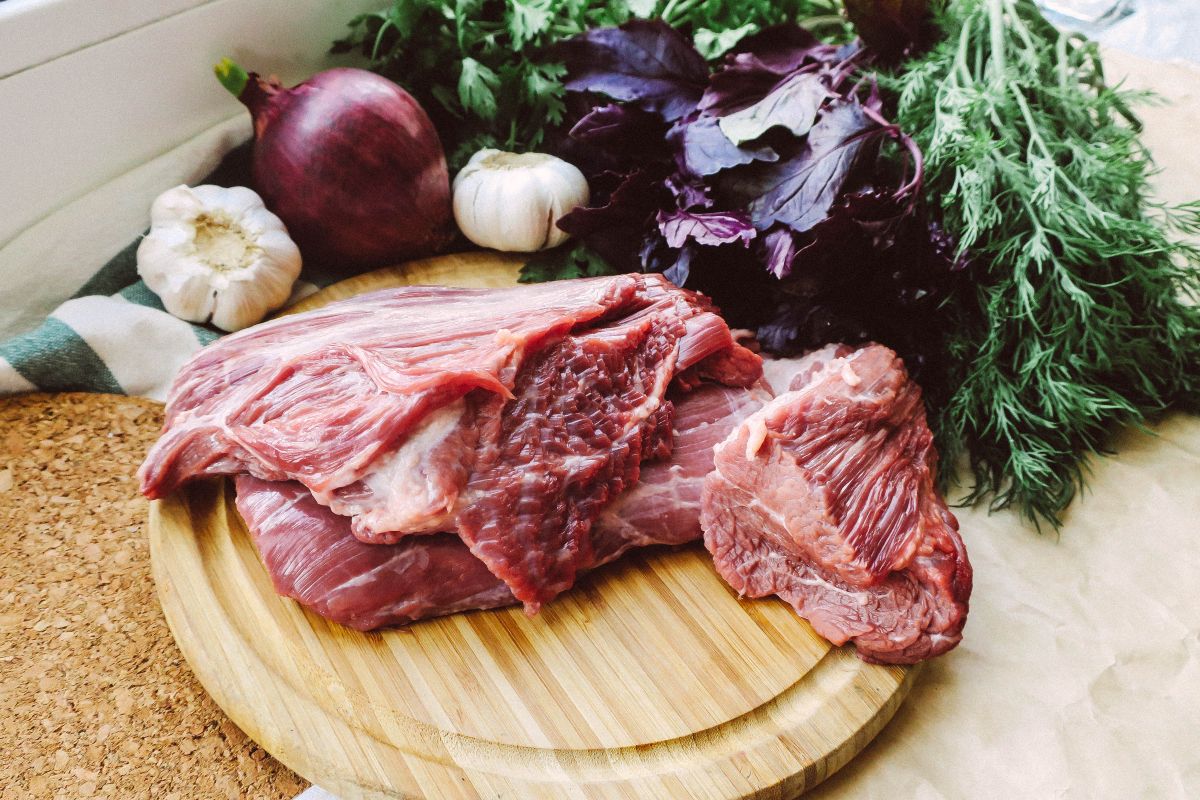
Raw meat often carries pathogens, and your dog can shed them without seeming sick at all. In households with young children, pregnant women, older adults, or people with weakened immune systems, health authorities advise against raw feeding. Transmission happens through fur, feces, the bowl, and sleeping areas, not just through what's in the bowl.
Raw meat isn't sterile, and with BARF that's more than a footnote. A study of 35 commercial frozen raw meat products found disease-causing pathogens in a substantial share: listeria in a good half of the samples, salmonella in a fifth, plus certain E. coli strains and some antibiotic-resistant bacteria. This isn't a one-off finding; agencies like the American FDA enforce zero tolerance for salmonella and listeria in pet food, precisely because raw products keep testing positive.
The key point for you at home: a dog can shed salmonella for weeks without showing any symptoms itself. Through fur, feces, and the emptied bowl, the pathogens make their way into your home. In one documented outbreak, dozens of people fell ill with a strain of salmonella traced back to raw pet food, including a child who developed a serious complication. That's why the clear recommendation is: in households with especially vulnerable people, raw feeding isn't a good choice. If you feed raw anyway, hygiene has to be taken seriously, there's a dedicated section on that below.
Bones are central to raw feeding and, at the same time, one of its trickiest aspects. As a calcium source and a form of enrichment, they have a place, but they carry a real risk of injury. Bones that are too hard or frozen can break teeth, and larger pieces can block the gut or, in the worst case, cause injury. You should be especially careful with very young and with older dogs.
One rule applies without exception: cooked, fried, or grilled bones never belong in the bowl. Heat makes them brittle, and they splinter into sharp shards. This applies to every type of animal and every method of preparation. If you give bones, they should be raw, sized to fit your dog, and always given under supervision.
Time for an honest tally of the promises. A shinier coat and smaller stools come up again and again, and both are explainable: the higher fat content can affect the coat, and good digestibility affects stool volume. But neither is unique to BARF; a good complete food achieves the same effect, and smaller stools aren't proof of a health benefit.
The sober bottom line: to date, there are no solid long-term studies showing that raw-fed dogs are healthier or live longer than well-cared-for dogs eating complete food. Reports of miraculous results are almost always individual experiences, not controlled comparisons. That doesn't invalidate personal observation, but it puts it in perspective. If you choose BARF, you're doing it out of conviction and care, not because of a proven health advantage.
To be fair, the same holds in the other direction: raw feeding doesn't automatically make anyone sick. Pathogen rates are elevated, the risk is real, but not every BARF dog and not every household comes away harmed. And processed dry food has had pathogen recalls too. The difference is one of degree, not black and white.
There are dogs and situations where raw feeding is not advisable without close professional guidance. The table below summarizes the most important ones.
| Situation | Why it's risky |
|---|---|
| Puppies, especially large breeds | Errors in calcium and energy cause lasting harm to bone growth |
| Pregnant or nursing females | Sharply increased, sensitive nutrient needs |
| Immunocompromised or sick dogs | Higher infection risk, often specific dietary requirements |
| Dogs with kidney, liver, or pancreatic disease | Need specifically adapted rations |
| Household with young children, pregnant women, seniors, or immunocompromised people | Pathogen risk for the people in the household |
The calcium issue weighs especially heavily for puppies, because a puppy's body can't excrete excess calcium and growth is sensitive to it. You can read about how delicate calcium is during the growth phase in the article Feeding puppies: how often, how much, and what food. If your dog falls into one of these groups, that doesn't necessarily mean "never BARF," but it does mean "not without a professionally calculated ration and veterinary guidance."
If you decide on raw feeding anyway, kitchen hygiene becomes a fixed part of daily life. Treat raw dog meat like raw meat for yourself, if anything, more carefully. Keep it frozen and thaw it in the refrigerator, not out in the open on the counter. Use separate cutting boards and knives, and thoroughly clean all surfaces, bowls, and hands after every contact. Raw pork is off limits, because it can transmit the Aujeszky virus, which is fatal to dogs. And don't let leftovers sit in the bowl for hours.
The reliable path to a truly balanced raw ration doesn't run through rules of thumb from forums, but through a calculated recipe. Veterinarians specializing in nutrition, or animal nutrition specialists, put together a ration that covers every nutrient, including any necessary supplements, and guide you through the switch. Periodic blood tests are also worthwhile, to catch deficiencies early. As with any food change, the switch should happen gradually, to go easy on the stomach; if digestive issues come up, the article My dog has diarrhea can help.
In the end, BARF is less a matter of belief than a matter of care. If you're willing to have a ration professionally calculated, take hygiene seriously, and keep a close eye on your dog, you can feed raw. If you'd rather not take that on, you're doing nothing wrong with a good complete food, quite the opposite. The idea that you have to pick a side helps no one, least of all the dog.
This article doesn't replace individual nutrition counseling. Specific rations belong in expert hands. What Souldog can take off your plate is the overview: in the app, you keep track of what your dog tolerates and how their weight develops, and the poison list is always just a tap away whenever you're unsure about an ingredient. The rest, the calm and the healthy skepticism toward promises that sound too good to be true, you bring yourself.
 Souldog