You talk to him like a roommate, and sometimes he looks at you as if he caught every word. Research has measured what's actually true here with surprising precision: fewer words than you'd hope, and far more connection than you think.

You're standing in the kitchen, telling your dog about your rough day, and he tilts his head. First to the left, then to the right, ears tuned in. In that moment, you'd swear he understands every word. Then you say "walk," just like that, right in the middle of a sentence, and the explosion of paws and joy tells you one thing for certain: that word landed.
ut what's actually happening behind those brown eyes? Does your dog understand you, or does he just read you? The research has an answer that's better than either option. Scientists have put dogs in brain scanners, played them foreign languages, and tested a Border Collie with a vocabulary of over a thousand words. What emerged is a picture that will probably surprise you: your dog understands fewer words than you'd hope, and at the same time, far more of you than you'd guess.
That sounds disappointing at first, but it isn't. "No grammar" doesn't mean "no connection." Your dog doesn't have a dictionary in his head. He has something else: a finely tuned system that pieces together what you mean from your voice, your posture, and the situation. Just how finely tuned becomes clear once you look inside his brain.
The most precise answers come from Budapest. There, a team led by neuroscientist Attila Andics trained dogs to lie wide awake and perfectly still in a brain scanner while their humans talked to them. The first major finding: dog brains have their own voice sensitive regions, located in almost the same spot as ours. And those regions respond to the emotional coloring of a voice much the way ours do.
The second finding is the one takeaway worth remembering from this whole article. The researchers played dogs praise words and neutral words, sometimes in a warm, praising tone, sometimes in a flat, indifferent one. The reward center only lit up when both matched: the right word in the right tone. A praise word said in a casual tone fell flat. A warm tone paired with a meaningless word did too. Your dog actually checks both things, the word and the music behind it, and only when they add up does praise actually feel like praise to him.
It goes even further. In a later study, the same lab played dogs Spanish and Hungarian. The brain scans showed that dogs recognize the sound patterns of their everyday language and tell them apart from an unfamiliar one, purely from years of listening, with zero vocabulary training. So if you've ever wondered "how" your dog knows English: he doesn't know English. He recognizes English. The same way you recognize a melody whose lyrics you never learned.
And a cautious glimpse ahead: in 2024, the Budapest team found an EEG signal worth noting. When dogs heard a familiar word and then saw an object that didn't match it, their brains measurably stumbled, very similar to the signal that shows up in us humans when a sentence doesn't make sense. It's a single, recent study, not yet confirmed. But it hints that words might trigger actual inner images in dogs' minds. As if "ball" didn't just trigger a behavior, but conjured up an actual ball.
Before you start counting along at home: 89 isn't a report card grade. It comes from a study where owners checked off which words their dog reliably responds to. Unsurprisingly, near the top were the dog's own name, "come," "sit," and "down." Whether a dog responds to 20 words or 200 says little about his intelligence and a lot about his daily life: a dog learns the words that matter to his life. If yours only knows 20, they're probably exactly the 20 the two of you need.
You may have also come across the figure "165 words, like a two year old child." It comes from a popular book and is based on an estimate from trainer surveys, not a vocabulary study. Linguists consider the child comparison misleading, because dogs lack something fundamental that every two year old has: grammar. A child eventually understands the difference between "the dog bites the man" and "the man bites the dog." A dog doesn't. He hears words, not sentences.
And then there are the outliers. The Border Collie Rico knew over 200 toy names and worked out new ones through a razor sharp process of elimination: unfamiliar word, unfamiliar toy, that must be it. Chaser, a female Border Collie, learned 1,022 object names over three years and could even tell the difference between fetching something, nudging it, or touching it with a paw. Before you give your own dog a disappointed look: Chaser trained four to five hours a day with a retired psychology professor. That's an elite athlete among word learners, not a benchmark.
The Budapest researchers are now searching worldwide for these "Gifted Word Learners" and have found only about 50 so far, most of them Border Collies, though even among Border Collies the vast majority don't have this gift. The most astonishing thing about this tiny elite: in one experiment, seven out of ten of these dogs learned a new toy name just by listening for eight minutes while two people talked about the toy. Nobody spoke to them directly. They simply listened. If a dog like that lives with you, he's probably listening in right now.
Now it gets practical, because words are just one channel among several for your dog, and not the most important one. In an Italian experiment, trained water rescue dogs were deliberately given conflicting signals: the word said one thing, the hand gesture said another. The result was clear: the dogs mostly followed the gesture. The word only won in one situation, when a spoken "come" went up against a "stay" gesture given from a distance. Being close to their person was apparently more tempting than any hand movement.
Behaviorists and trainers largely agree on this, even though no single study has measured this exact ranking: your dog reads your body first, then the situation, then your tone, and only last, the word. What you say is often just the subtitle track to a movie he already figured out.
| What You Do | What Your Dog Actually Gets |
|---|---|
| You reach for the leash and casually say "in a minute" | Leash! It's happening, no matter what you say |
| You say "sit" while leaning forward | Mostly the body movement, the word just tags along |
| You praise with a warm tone and the right word | Bullseye in the reward center |
| You scold with a smiling face | A confusing mixed signal |
| You call his name in a noisy crowd | He filters it out, surprisingly reliably |
That last row, by the way, is meant literally. In one experiment, dogs recognized their own name from a wall of recorded chatter even when the noise level was so high that one year old human babies could no longer pick out their own name. Your dog absolutely can hear you calling him at a crowded dog park. Whether he then comes is a different question, and it ties into another research finding: what dogs learn is strongly tied to place and situation. A "sit" that works perfectly in the quiet kitchen essentially doesn't exist yet on the exciting meadow. That's not defiance, it's how learning works biologically; commands have to be re-earned in every new place.
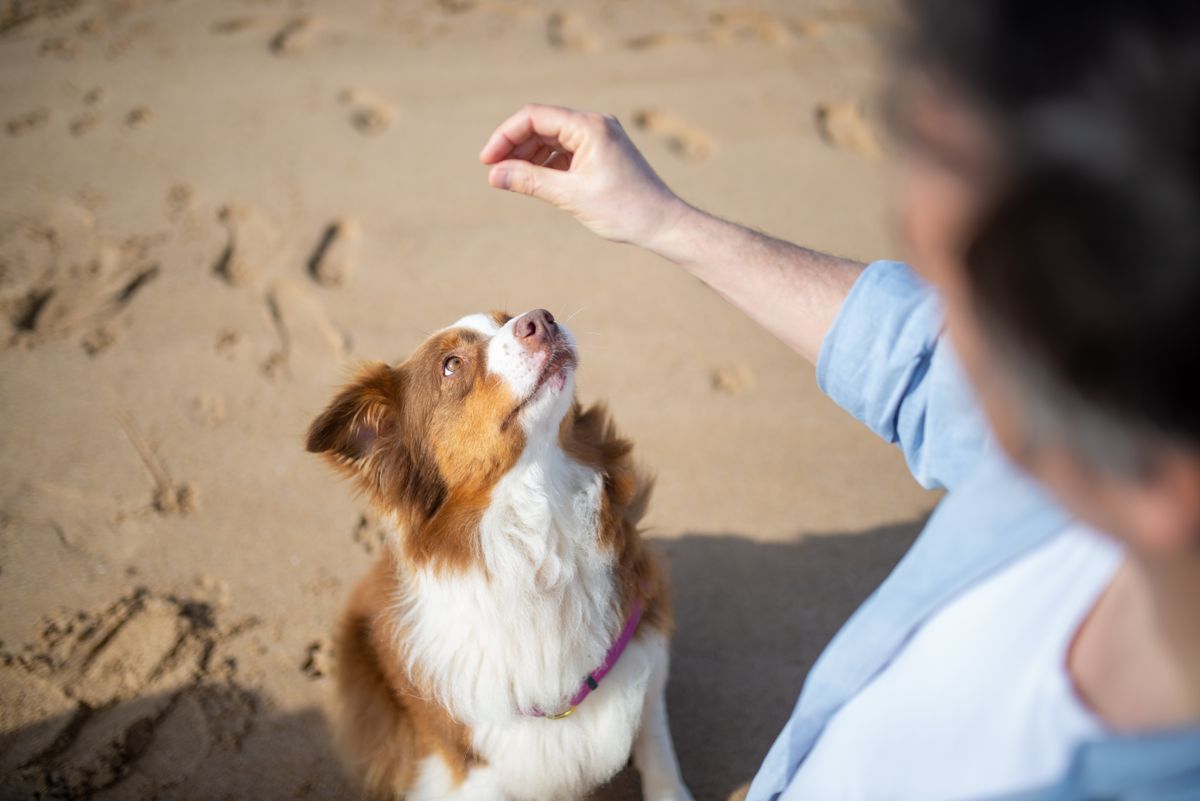
You know that voice. Two octaves higher than normal, "Who's the best boy in the whole wide world?", and if pressed, you'd deny it was you. The good news: the research is on your side. Dog brains respond more strongly to this exaggerated, singsong way of talking than to a normal adult tone, especially to high pitched, heavily modulated female voices. And a British experiment found a charming detail: baby talk works best when it's filled with dog relevant words. "Want to go for a walk, who's a good boy?" said in a singsong voice beats both singsong nonsense and dog relevant words said in a flat office voice. Your dog wants both: his favorite topics, in his favorite melody.
That leaves the question behind the question. When you tell him in the evening that your day was rough, does any of it get through? Not the words. But dogs can demonstrably tell happy human faces from angry ones, even faces they've never seen before. And they connect what they see with what they hear: in experiments, dogs looked longer at the face whose expression matched the tone of voice they'd just heard. So your dog cross references your expression with your tone and forms an overall impression of how you're doing. What he does with that, the closeness, the quiet lying down next to you on hard days, is one of those things you don't really need to explain. You can read how to deliberately strengthen that connection in our post on showing your dog love, and everything his body is telling you in the meantime is covered in our guide to dog body language.
The head tilt is still a mystery. It shows up noticeably often in gifted word-learner dogs when they hear a familiar word. What it means in the average dog is still an open question: better hearing, a clearer view past their own snout, or simply learned behavior because we melt every single time. It's not proof of understanding. That doesn't make it any less adorable.
All this research boils down to a small set of everyday instructions:
And the talking in between, all the ordinary chatting with no command attached? Please, keep it up. Your dog learns the melody of your everyday life from it, and the research on those eavesdropping exceptional dogs suggests that more sticks along the way than we long assumed. Words he knows, patterns he loves, and above all, your voice, which his brain demonstrably responds to differently than any other. What your scent alone sets off in his head is covered in our post on separation anxiety in dogs; and if you're curious why his barking has just as many shades going the other direction, read our in depth post on what dog barking really means.

In the end, there's one insight left that's better than any vocabulary list. Your dog will never know what "rough day" means. But he recognizes your footsteps on the stairs, his name in the middle of the biggest commotion, the warmth in your tone before you've even noticed it yourself, and that one word for walk, buried in the middle of your longest sentence. His vocabulary is small. But you are on every page.
If you want to find out how much gets through between the two of you, turn it into a little game: spend a week watching which words your dog really responds to, and you'll be surprised how many there are. In the Souldog app, you can log observations like these and discover outings nearby where you can put your shared language to the test right away. The next "walk" is guaranteed to land.
 Souldog