Safe retreat or glorified cage? Crate training is one of the most hotly debated topics in dog ownership. Here's what the research actually says, where the honest limits are, and how to decide whether a crate is right for your dog.
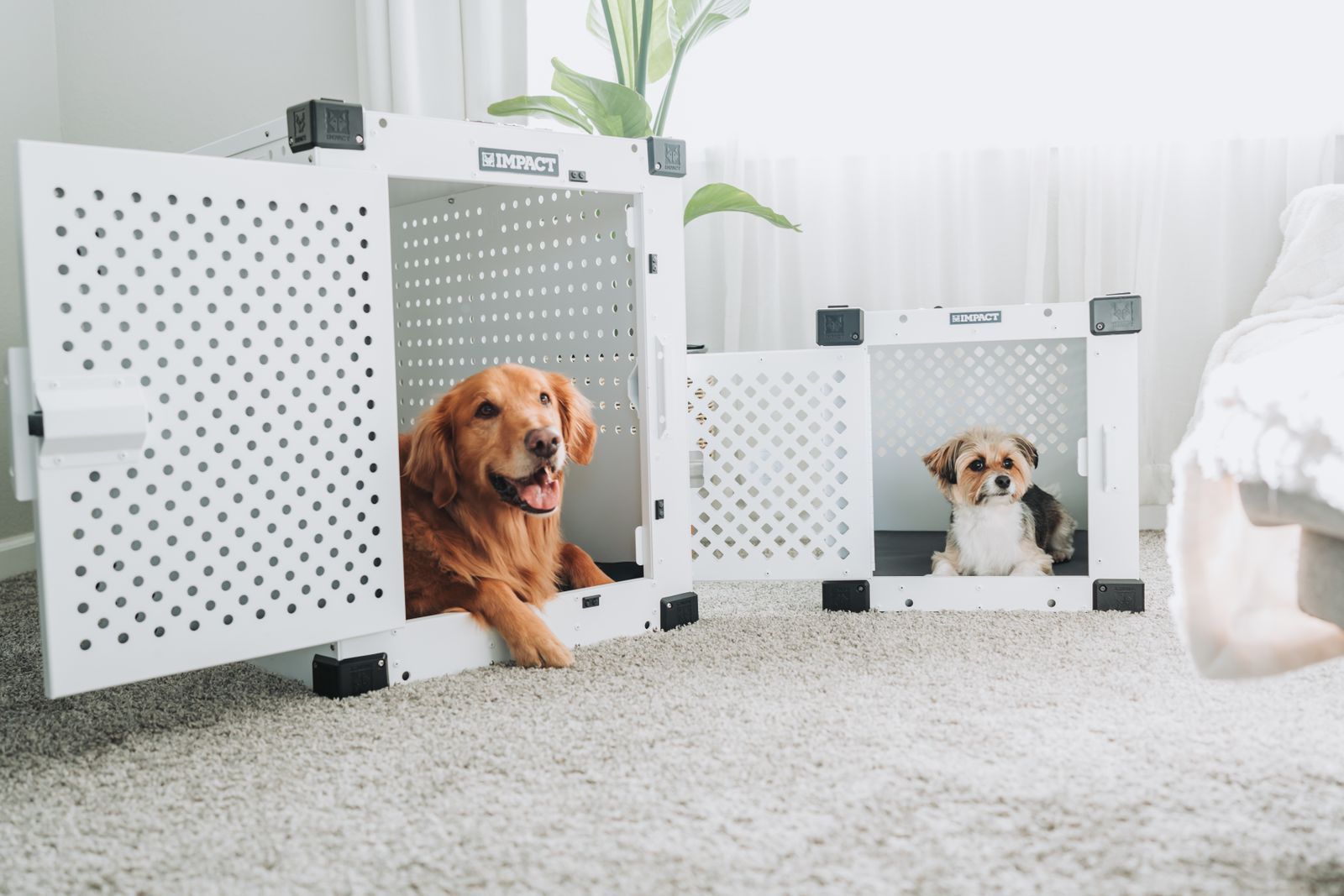
The crate has been sitting in your living room for two days, and you're starting to wonder whether it was a clever idea or just an attractively packaged cage. Some people swear by them, their dog finally has a safe spot all his own. Others raise an eyebrow and call the whole concept borderline cruel. Both camps argue with total conviction, and you're stuck in the middle just wanting a straight answer: yes or no?
he honest answer is uncomfortable, because it doesn't make a good headline. It is: it depends. Not whether you use a crate, but how you use it determines whether it's a gift or a problem. So let's look at what studies and real-world experience actually say, rather than what the internet shouts the loudest.
That is exactly where the heated debate goes wrong. The question is rarely whether a crate should be allowed at all, but what it is being used for. A crate that a dog has learned to love and chooses to enter on his own has almost nothing in common with a dog waiting out an eight-hour work day behind a locked door. Keep those two pictures separate and most of the confusion clears up quickly.
Crate training means gradually introducing a dog to a defined, enclosed space. That might be a wire crate, a plastic travel carrier, or a soft-sided fabric version. When used well, it meets a few genuine needs.
For house training, a crate helps because most dogs instinctively avoid soiling their immediate sleeping area, which means they're more likely to signal they need to go out rather than just going right there. As a retreat, a crate with the door permanently open can become a quiet corner a dog chooses on his own when the house gets busy. For travel and vet visits, early positive crate experience pays off, a dog who knows and trusts a crate stays noticeably calmer in the car, on a plane, or in a clinic kennel. And after surgery, when strict rest is prescribed, a crate can safely limit movement during recovery.
Those are the situations where crate training earns its place. What they all have in common: limited time, and a dog who experiences the crate not as punishment but as something familiar and safe.
Dogs are not born den animals. The most popular argument for crate use doesn't hold up to scrutiny. Wolves use dens almost exclusively for raising pups, not as a regular resting place. Free-ranging dogs choose their rest spots based on open sightlines and proximity to people, not on enclosed spaces.
You've probably heard it: dogs love crates because they're natural den animals. It sounds convincing. It's not quite right. Adult wolves prefer resting in the open with a clear view around them, and observations of free-ranging dogs show the same pattern. What is true is that some individual dogs do develop a preference for tight, quiet spots. That's learned behavior, not an inborn instinct. In practical terms, nearly every dog needs to be introduced to a crate carefully. A genuine instinct wouldn't require training.
Why does this matter? Because the den myth is often used as a free pass, the dog wants this, so it must be fine. He doesn't want it naturally. He can learn to like a crate, and that's a real training success worth celebrating. But it's not a law of nature that justifies long periods of confinement.
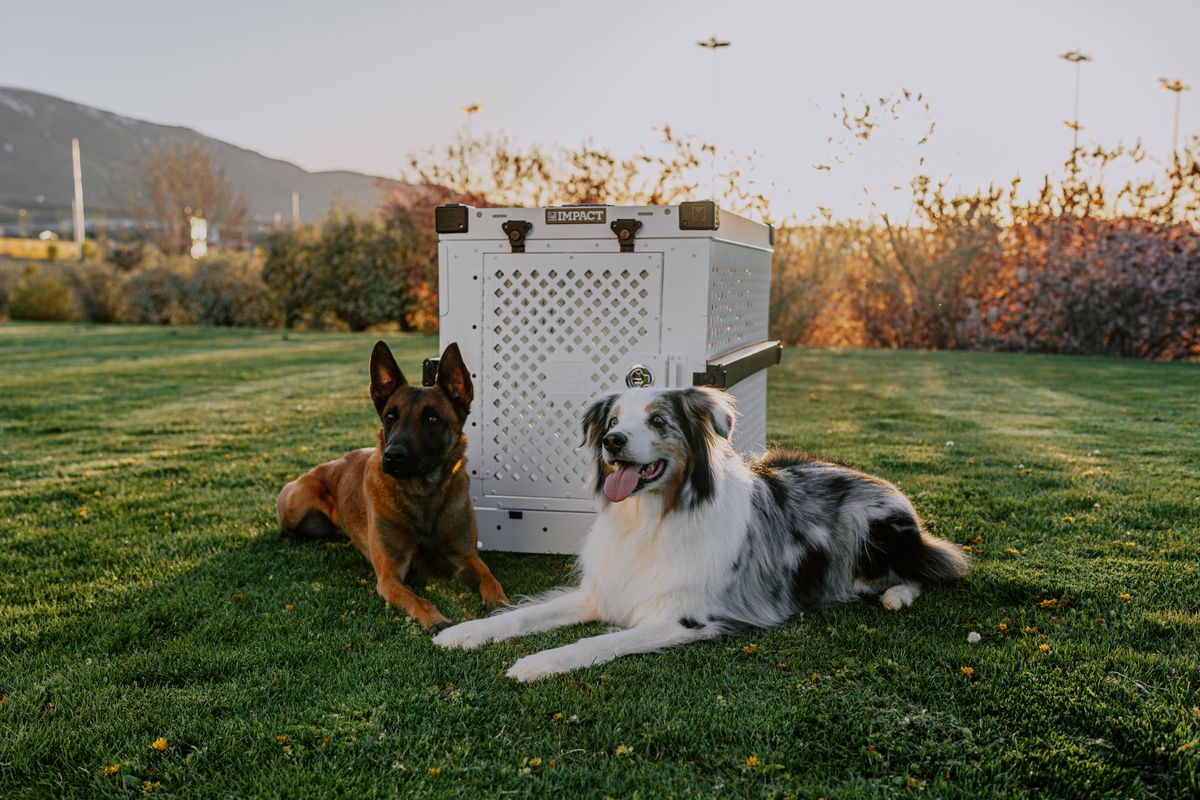
A fair assessment needs both sides. Start with what's well-supported in favor of crates, then look at the downsides.
On the plus side: a positively introduced crate supports house training, demonstrably keeps dogs calmer through vet visits and travel, and can give an insecure dog a solid anchor point. In clearly limited moments, when contractors are working in the house, for example, a crate is a practical short-term solution.
Against that, there are real risks that shouldn't be minimized. When a crate becomes a long-term solution, constant confinement can lead to frustration and stress. When it's used as punishment, everything flips, your dog starts associating it with something negative, and the safe haven is gone. And as a fix for behavioral problems, a crate simply doesn't work. A 2024 international survey of behavior specialists found that crates are largely ineffective to actively harmful when it comes to behavioral issues. A crate can contain a dog. It cannot solve a problem.
This is where things need to get concrete, with no room for nuance. A crate must never become a permanent living situation. Clear guidelines have become established for a reason.
For puppies, the rule of thumb is: age in months plus one hour is the maximum time a puppy can reliably hold his bladder. Bladder control begins to develop from around 12 to 16 weeks, but is not reliable until about five to six months of age.
| Dog's age | Maximum crate time at once |
|---|---|
| 8 to 10 weeks | 30 to 60 minutes only |
| Around 3 months | About 3 to 4 hours |
| 4 to 5 months | About 4 to 5 hours |
| Adult dog | 4 to 5 hours maximum, shorter is better |
These numbers are ceilings, not targets. There is no fixed legal hour limit, and each case is judged individually, but a full work day in the crate (eight hours or more) is regarded by professionals and in case law as not consistent with animal welfare. In German-speaking countries, crate use is viewed more critically than in the US, and for rest or training purposes alone, experts here typically recommend considerably shorter windows. Anyone who regularly needs to leave a dog alone for many hours needs a different solution than a crate, whether that's a dog sitter, daycare, or a safely gated room.
When a dog has true separation anxiety, confinement is the wrong approach. A crate may prevent damage to your home, but it can intensify the panic. Anxious dogs injure themselves trying to escape through wire and doors. Separation anxiety requires targeted behavior modification with professional guidance, not a closed door.
There are situations where crate use is not just unhelpful but actively harmful. The most important one you just read: you cannot lock separation anxiety away. Beyond that, there are a few other firm limits.
A crate must never be used as punishment. The moment your dog is sent in there because he did something wrong, it becomes a place of fear, and the idea of a safe retreat is destroyed. If your dog already shows distress around the crate, panting, drooling, scratching, whining, further confinement is the wrong move, and patient counter-conditioning needs to come first. And putting a dog in a crate that's too large, where he can relieve himself in one corner and lie in another, doesn't help with house training. It just forces him into an unpleasant situation with no benefit.
If you decide a crate is the right choice, the introduction is everything. The core principle is simple: no pressure, always voluntary, door stays open at the start.
Put the crate where life happens. Don't tuck it away in a far-off basement room. Place it where the family spends time. A retreat can be quiet, it shouldn't feel like exile.
How long this process takes varies from dog to dog. Some settle in within a week. Others need several weeks. An adult dog can absolutely learn to love a crate too, as long as he isn't carrying bad memories of one. If he is, a dog trainer who works without coercion is worth the investment.
That brings us back to the original question, and now you have what you need to answer it for yourself. A crate as a voluntary, positively associated retreat with the door left open, for manageable periods of time, properly introduced: yes, that can be genuinely useful for many dogs and situations. A crate used as a daily holding pen across a full work day, as punishment, or as a supposed solution to separation anxiety: no, the harm outweighs any benefit.
Bringing a new dog home raises a lot of questions, the right place to rest, how to handle uncertainty, how to help an insecure dog feel grounded. You can read more about that in our guide on settling in a rescue dog gently. And if you want to understand just how much sleep and rest dogs actually need, we cover that in the post about sleep and dreaming in dogs.
Crate training isn't a belief system that puts you in one camp or another. It's a tool, and like any tool, it's only as good as the hands using it. A crate your dog walks into on his own terms and visibly enjoys is a small refuge. A crate used to lock him away is the opposite. The difference is yours to make.
When a new four-legged family member moves in, Souldog helps you keep track of everything, from the first days of settling in to rest routines and early training steps. So your dog finds his place with you, one he chooses for himself.
 Souldog