From lip licking to yawning to walking in a curve: which quiet signals show your dog is stressed, which ones are easy to mix up, and how to respond the right way in everyday life. Honestly sorted by what's actually proven and what isn't.

You're out on a walk, another dog approaches, and yours suddenly starts sniffing the ground intently, as if it just found the most interesting scent trail of its life. Coincidence? Probably not. You likely just saw a calming signal, a quiet message your dog uses to say, "This is a bit much for me right now." Dogs are constantly talking to us and to each other, just in a very subtle language that we humans often miss completely.
his guide takes a deep look at exactly this quiet language. We go through the signals one by one, in as complete a list as possible, and cover which ones are easily confused with something harmless, which situations trigger them in humans, and how to respond the right way in everyday life. And we stay honest about what the science actually shows versus what's interpretation. For an overview of the full body language picture, including tail, ears, and posture, check out our complete guide to dog body language; this article focuses specifically on calming signals.
The term goes back to Norwegian dog trainer Turid Rugaas, who described around thirty such signals in her book on calming signals. Her core idea was that dogs use these gestures actively to calm themselves and the other party and to avoid conflict.
This is a good place for honesty right from the start, because this is exactly where the claim and the evidence diverge. Rugaas's work rests on decades of careful observation, not a controlled study. What research has since confirmed well: these signals reliably correlate with stress and tension. What it hasn't been able to confirm cleanly: that the dog uses them to deliberately and intentionally calm the other party. For your everyday life, the practical takeaway is the same either way: take these signals seriously as honest stress indicators from your dog.
Here are the signals at a glance, each with a short explanation. Further down, we'll take a closer look at the tricky mix-ups.
This list is deliberately long, because many guides only mention a handful of signals. In practice, it's rarely about a single one, but about how they work together, more on that in a moment.
The most common mistake when interpreting these signals is reading every single one as stress right away. Almost all of them also have a harmless explanation. This is exactly where good observation parts ways with overinterpretation.
Lip licking is a textbook example. It can mean stress, but it can just as easily mean anticipation of food, a quick lick after eating, or, importantly, a sign of nausea or dental and mouth pain. If your dog licks its lips constantly with no recognizable social trigger, that calls for a vet visit rather than a behavioral interpretation.
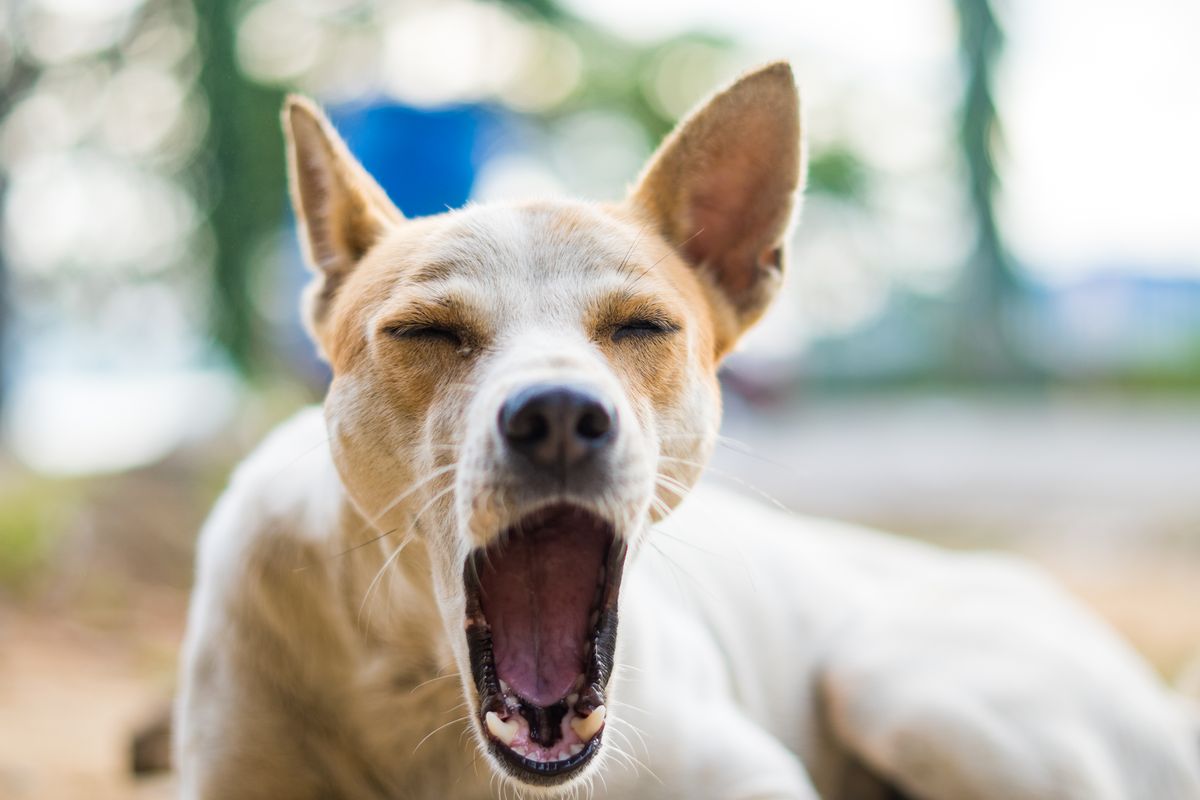
Yawning often means stress, but sometimes it's simply that the dog is tired or just waking up. Timing is what matters. If it yawns in the morning on its bed, it's tired. If it yawns at the vet, in a crowd, or while you're scolding it, that's tension.
Ground sniffing can be a calming signal or simply genuine interest in a scent trail. Context reveals the difference: if it sniffs calmly and thoroughly across a meadow, something really does smell good. If it sniffs frantically at the exact moment an unfamiliar dog appears, that's a signal.
Lifting a paw is described as a conflict signal, but it can also be a trained "shake" cue, a hunting dog's point, or a sign of leg pain. And scratching in the middle of a training session is often a displacement behavior, but it can of course also be genuine itching from fleas or a skin condition.
Behavioral science calls many of these behaviors displacement activities: normal actions that show up at the wrong moment because the dog is caught in an inner conflict. They reveal its emotional state. Whether the dog also means to communicate something on purpose remains an open question, and that's exactly why a level headed view pays off: take the signal seriously, but don't turn every lick into a drama.
If your dog yawns once, it might just be tired. If it yawns, licks its lips, turns its head away, and makes itself small while a child gets too close, the message is clear. Experts call this "stacking" of signals: the more of them appear at the same time, the more certain the interpretation. So never rely on a single puzzle piece, but on the picture they form together.
On top of that, not every dog can "speak" equally clearly. Short nosed breeds with flat faces show less facial expression, dogs with docked tails or cropped ears are missing part of their expressive range, and fine signs simply disappear in very thick or dark fur. With these dogs, you need to pay even closer attention to the remaining signals and the whole scene.
An uncomfortable but important point: often we humans are the reason a dog is signaling calming behavior in the first place. A lot of what we mean affectionately lands on the dog as pressure. This isn't a reproach, it's an invitation to see your own behavior through a dog's eyes.
Some of the most common human triggers include:
The practical takeaway is simple: let unfamiliar dogs decide for themselves whether they want contact, don't stare at them, don't lean over them, and pet them from the side at the chest and shoulder rather than from above on the head. Small change, big effect.
Calming signals are a request, not a trick to be trained away. The right response is correspondingly simple, even if it takes patience in the moment.
If your dog shows these signals, take the pressure off: end or change the situation, create distance from the trigger, give your dog room instead of expecting it to "push through." That's the core of it. What you should never do is punish or ignore the signal. This is where things circle back to growling: if you brush off or talk over early, quiet warnings, your dog learns that they don't work. Eventually, all it has left is the louder level.
Film your dog in typical situations. On video, you can calmly spot the quiet signals you miss in the moment. Especially when your dog is alone or meeting other dogs, the recording often reveals more than being there in person does.
One important addition on taking this seriously: if a supposed calming signal shows up unusually often, like constant lip licking, nonstop scratching, or noticeable panting with no social trigger, consider a medical cause too. Not everything that looks like communication is communication. Sometimes it's simply nausea, itching, or pain behind it, and then the dog belongs at the vet, not in behavior training.
In the end, it's like any good relationship: it thrives on one side listening to the other. When you notice and respect your dog's quiet signals instead of talking over them, it feels understood and rarely needs to raise its voice. And you get a dog that trusts you, because it knows its voice reaches you.
 Souldog