What age your dog can start hiking, how to build up fitness together, what belongs in your backpack, and which dangers on the trail actually matter: the honest hiking guide so a beautiful day doesn't end at the vet.
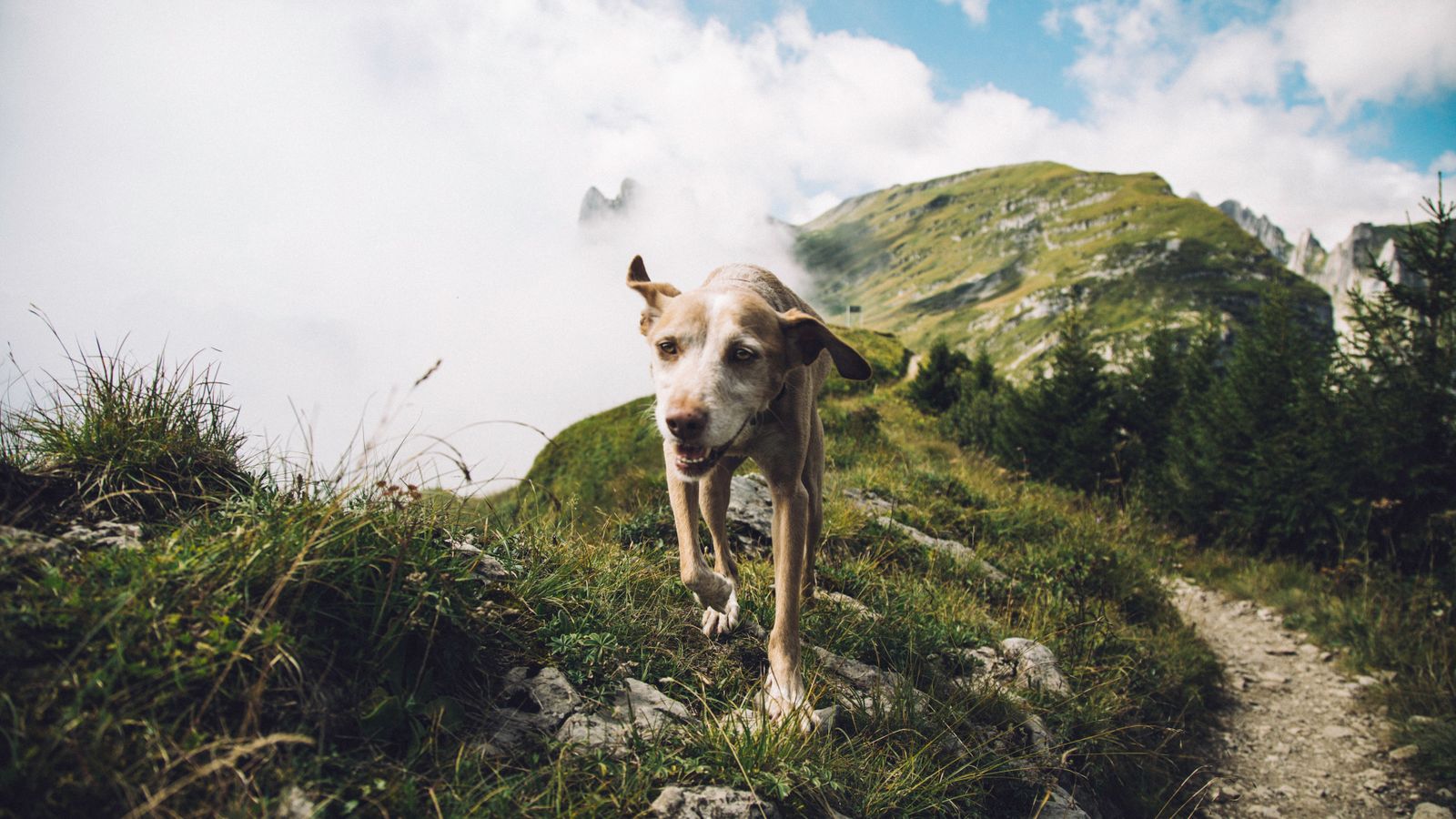
The alarm goes off at six, the backpack is packed by the door, and your dog is already dancing through the hallway like he planned the route himself. Hiking is one of the best things you can do together: hours outside, a destination ahead, both of you pleasantly worn out on the couch by evening. But not every dog can simply join a full day's hike. Some are too young for it, others too short nosed, and some are just untrained. And a few dangers on the trail catch even experienced hikers off guard.
ead this guide as preparation before your first real hike: which dogs are actually built for hiking, what age a young dog can start at, how to build up endurance, what belongs in your backpack, and which small saboteurs lurk along the trail. By the end, you'll know exactly what it takes to make the hike a good day for both of you.
Whether a hike is right for you and your dog depends less on enthusiasm than on your dog's body and your preparation. A young, healthy mixed breed with a training base will happily outrun you for a full day. A pug at 25 degrees will struggle after two kilometers. This table sorts out the starting point before we go into detail.
| Situation | What it means for the hike |
|---|---|
| Healthy, adult, trained dog | Day hikes are possible, but still build up fitness gradually |
| Puppy or young dog before skeletal maturity | Only short, calm walks, no long or steep routes |
| Short nosed breed (pug, bulldog, boxer) | Only in cool weather, short distances, heat is dangerous |
| Senior dog or dog with arthritis | Shorter, more frequent hikes on soft ground |
| Heart condition, overweight, under treatment | See a vet first, no demanding hikes without clearance |
Now let's go through the rest step by step.
The honest answer is: most dogs, yes, but not all, and not in every weather. A few groups need extra caution, and for them, care always comes before ambition.
Short nosed dogs top the caution list. Pugs, French and English bulldogs, boxers, and Pekingese can't dissipate heat through breathing as well as long nosed dogs. A large study of over 900,000 dogs shows just how much the risk rises: English bulldogs suffered heatstroke roughly fourteen times more often than Labradors, French bulldogs about six times more, and pugs three times more. For these breeds, the rule is: only short distances, only in cool temperatures, and a walk is better than a mountain hike.
Very young dogs also don't belong on long routes yet, more on that below. Seniors and dogs with arthritis can still join, but need adjusted hikes: more often but shorter rather than rarely but long, soft forest ground instead of loose rock, and breaks before the dog has to ask for them. Talk to your vet before the first bigger hike if your dog has a heart condition, is significantly overweight, or just had surgery. Not as a formality, but because your vet can judge your dog's circulation far better than any rule of thumb.
Long, demanding hikes only make sense once the growth plates have closed. For small breeds that's usually around six to ten months, for medium breeds around twelve months, and for large and giant breeds not until fifteen to eighteen months, sometimes even twenty four months. Until then, short, calm walks are fine, long or steep hikes are not.
The reason lies in the skeleton. Growth plates are soft cartilage zones at the ends of the bones that a young dog is still growing from. They're more sensitive than fully formed bone, and sustained, repetitive strain like miles of trotting or jumping on hard ground can damage them. Free play with self-imposed breaks is different from a continuous hike where the dog has to keep up because you set the pace.
You may have heard the popular rule of "five minutes of exercise per month of age." At best it's a rough guideline for very young puppies, but it's not a medical limit and has no scientific backing. Its origin is an old, often misquoted study on kenneled dogs. Trust common sense instead: short rounds, lots of sniffing rather than mileage, and for large breeds, when in doubt, ask your vet before the first real hike.
A dog who normally goes around the block twice a day won't manage a full day's hike just because he has four legs. Fitness builds up for him step by step, the same way it does for you. Skip that, and you risk sore muscles, blistered paws, and a dog who refuses the next hike right at the front door.
Start with distances your dog handles easily, and increase the distance gradually, week by week, not from zero to twenty kilometers in one weekend. Vary the terrain so paws and joints get used to forest floor, meadow, and gravel. Build in a warm-up and cool-down: the first and last few minutes at a relaxed pace, not straight uphill. A dog at a healthy weight, neither too thin nor too heavy, has the easiest time of it. And if he lags behind, sits down, or falls back on the trail, that's not disobedience, it's a signal. That means the hike is over for the day.
Hiking needs less gear than the outdoor industry wants to sell you, but a few things really do belong on the list. A well-fitted harness is the foundation. If your dog pulls, or you need to support him over a root step, a harness spreads the force across chest and shoulders instead of concentrating it on the neck. A sharp jerk on a collar can strain the throat and cervical spine.
Here's what goes on your packing list:
What you don't need is a fully loaded dog backpack for an untrained dog. Added weight is something for trained, fully grown dogs, not for the first outing.
Overheating is the most underestimated risk on hikes, because your dog keeps running along in his enthusiasm instead of slowing down himself. At a core body temperature of around 41 degrees, it's considered heatstroke, and that's an emergency. The warning signs usually build up in this order: first heavy, frantic panting and lots of drooling, then a deep red tongue and a fast pulse, later stumbling, pale or bluish gums, vomiting, and in the worst case, collapse.
If you see these signs, stop immediately, get your dog into the shade, and cool him with cool to cold water, cool first, then get to the vet. The old rule about never using cold water is considered outdated. Prevention is still better: hike early morning or evening on hot days, avoid the blazing midday sun, take regular breaks in the shade, and offer water often. There's no fixed amount of water per hour, but noticeably more than on a normal day is the right direction. For short nosed dogs, even moderate warmth is enough to become critical.
The small saboteurs of a hike rarely lurk in the big terrain, they're on the ground. Sharp rocks, loose gravel, and hot stone can tear or burn paw pads, and torn pads heal poorly because the dog keeps pulling at them with every step. Check your dog's paws during and after the hike. On hot ground, the simple back-of-the-hand test works: if you can't hold the back of your hand on the surface for seven seconds, it's too hot for paws too.
Ticks are a year-round concern, especially in forests and meadows. Experts recommend risk-adjusted, often year-round tick prevention plus a thorough check after every outing. If you find a tick, remove it close to the skin with a tick remover or hook, without twisting or squeezing. You'll find the exact steps in our guide on removing ticks from dogs.
In summer, grass awns join the list, the sharp seed heads of grasses. Their barbs let them burrow into the spaces between paw pads, ears, nose, or eyes, and migrate further from there. If an awn is lodged in an ear, nose, or eye, don't try to remove it yourself, leave that to your vet.
The higher and steeper the hike, the more caution your dog needs. Via ferratas, exposed sections, and long stretches of loose rock aren't suitable for most dogs, and any spot where you'd need to carry your dog or put him in a backpack is a sign to rethink the route.
On altitude sickness, honesty matters: dogs can show symptoms at high altitude that resemble human altitude sickness, such as shortness of breath, heavy panting, lethargy, or coordination problems, usually starting around 2,400 meters. The exact mechanism isn't well studied in dogs, though, and there are no reliable thresholds. Short nosed and heart-compromised dogs are considered more susceptible. Treat altitude with respect rather than panic: ascend slowly, watch your dog, and descend at the first sign of trouble instead of pushing on.
Germany has no single nationwide leash rule for forests. Leash requirements in forests and nature reserves are set at the state level, and the rules differ from state to state and often from area to area. In many states, a leash requirement applies in forests during breeding and rearing season, usually from around March or April to mid-July, and in nature reserves it's often year-round or stricter. Violations can get expensive. So check the rules for your specific area before every hike.
Wildlife and grazing livestock are the second good reason for a leash. A dog chasing after deer puts the wildlife and himself at risk. If you come across a herd with livestock guardian dogs, keep your distance, stay calm, and go around the herd in a wide arc. Your leashed dog should stay right at your side.
Back at the car or at home, a quick check over your whole dog is worth it before you both collapse on the couch. These five minutes catch most small problems before they become big ones.
Check the paws for cuts, foreign objects, and grass awns between the toes. Search fur and skin for ticks, especially around the ears, armpits, and groin. Watch your dog over the next day or two: is he eating normally, moving easily, in good spirits? Persistent limping, loss of appetite lasting more than a day, or vomiting call for a vet visit. Shortness of breath, collapse, or pale to bluish gums are an immediate emergency.
Hiking with your dog isn't a competitive sport or a race for kilometers. It's a long day outside where you rely on each other: you on his nose and his joy, him on your pace and your care. If you know his build, build up fitness slowly, and keep an eye on the small dangers along the trail, the outing becomes exactly what it's meant to be.
If you're looking for more ideas, our full overview of activities with your dog has plenty, from dog sports to swimming. For staying safe in the heat, take a look at our guide on protecting your dog in summer. And for beautiful hiking trails and dog-friendly spots near you, Souldog shows them right on the map.
 Souldog