What age your dog needs to be before running alongside your bike, which dogs shouldn't do it at all, the right gear, and step-by-step training: here's how biking with your dog becomes safe instead of risky.
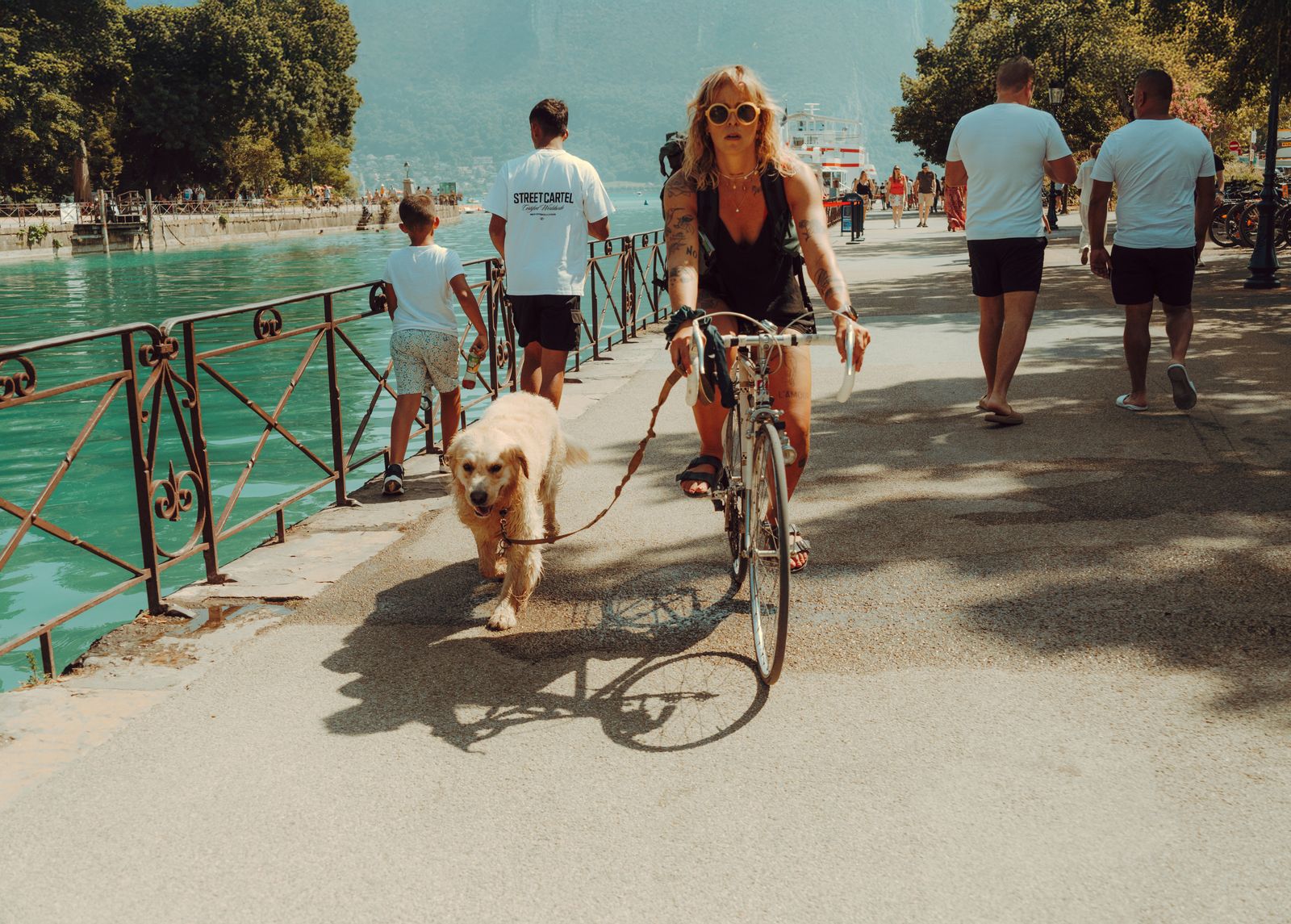
You're rolling easily down the dirt path, your dog trotting loosely beside you, ears catching the wind, and for a moment you look like the perfect team. That's exactly how it can look. But between that picture and a cyclist sprawled on the roadside with a jerked dog beside them lie a few decisions that a lot of people make too late: the wrong age, the wrong pace, a collar instead of a harness, the leash held loose in one hand.
or a lot of energetic dogs, biking together is a wonderful way to burn energy, as long as the body is up for it and the preparation is right. In this guide, we'll walk through when your dog is ready for biking, which dogs are better off skipping it, which gear actually matters, and how to build it up in small steps until it feels safe.
Whether your dog should run alongside your bike comes down to three main questions: Is your dog physically mature and healthy? Is the gear right? And is it cool enough outside? This table sorts out where you stand.
| Situation | What it means for biking |
|---|---|
| Healthy, fully grown dog with a sound build | Generally suited, build up pace and distance slowly |
| Puppy or young dog before skeletal maturity | Not ready for biking yet, growth plates need to close first |
| Brachycephalic breed (Pug, Bulldog, Boxer) | Not suited, breathing and heat regulation aren't up to it |
| Very small dog, or very large, heavy dog | Not suited, or only with great caution, due to stride length and joints |
| Senior dog, arthritis, heart condition, overweight | Better off in a trailer or basket, check with the vet first |
| Warm or hot weather | Don't ride, the bike tempts you to push your dog too far |
Now let's take a closer look at the rest.
Trotting alongside a bike is an endurance sport. Your dog moves at a steady pace, one that you set rather than your dog. That works well for a lot of healthy, energetic medium to larger dogs. For some groups, though, it's simply not a good idea.
Brachycephalic dogs clearly don't belong at the bike. Pugs, French and English Bulldogs, Boxers, and similar breeds get less air through their narrowed airways and struggle to release heat. They overheat faster, and having to keep pace steadily at the bike, without the ability to slow down on their own, pushes them to their limit especially easily.
Very small dogs have a hard time because their stride doesn't match the bike's pace: they'd need to run flat out where your dog should be trotting. Very large and heavy dogs, as well as giant breeds prone to hip or joint problems, need extra caution, especially with sudden starts and stops. And senior dogs, dogs with arthritis, heart disease, or significant excess weight are better off not running alongside the bike at all, but riding in a trailer or basket instead. Whenever there's an existing health condition, talk to your vet before the first outing.
A dog shouldn't run alongside a bike until its growth plates have closed. For small and medium breeds, that's usually the case at eight to twelve months, for large breeds not until twelve to eighteen months, and for giant breeds sometimes not until eighteen to twenty-four months. Before that, the steady trotting that biking demands has no place on a still-developing skeleton.
Why this matters so much comes down to the difference between playing and biking. During free play, a young dog takes its own breaks, changes pace and direction, and rests when tired. At the bike, it keeps moving at one steady rhythm, mile after mile, because it wants to stay beside you. That repeated, one-directional strain wears on still-soft growth plates and young joints far more than the varied chaos of play does. For large breeds, it's worth confirming the right timing with your vet before the first real bike outing, with an X-ray if there's any doubt. The general age ranges you'll see floating around are only rules of thumb, not a substitute for looking at your own dog.
When it comes to biking with your dog, the gear determines safety, not comfort. Two things are non-negotiable: a well-fitted harness and a secure connection to the bike.
A harness instead of a collar is mandatory. If your dog pulls at the bike, or gets startled and darts sideways, a collar delivers a hard jolt straight to the throat and neck vertebrae. A study on dogs found that force on a chest harness spreads across a larger area, while on a collar it concentrates on the sensitive neck. No attachment point is completely risk-free, but a properly fitted harness that keeps pressure off the neck is clearly the better choice.
For the connection to the bike, use a rigid bike attachment arm, often called a springer: a spring-loaded bar mounted to the frame that keeps your dog at a safe distance and absorbs sudden pulls. That way your hands stay on the handlebars, where they belong. Holding the leash loosely in your hand is the riskiest option, because a single jolt can pull you off the bike. Water and a collapsible bowl belong on every ride longer than a short loop.
Not every surface is equally good for paws and joints. Solid asphalt is hard and heats up a lot in the sun, while soft dirt and forest trails are easier on the joints and cooler. Where you have a choice, the softer path is the better one.
In summer, ground heat adds another layer to worry about. Asphalt can heat up well beyond air temperature, reaching over 50 degrees Celsius when the air itself is only 25 degrees, and paw burns are possible within a short time starting around 49 degrees Celsius. The simplest test is the back of your hand: hold it on the surface for seven seconds. If you can't stand it, it's too hot for your dog's paws too, and you're better off not riding.
Biking carries its own particular risk: you set the pace, not your dog. On a regular walk, a dog simply stops when it gets too warm. At the bike, it keeps going because it wants to stay beside you, even once it's long past its limit. That's why dogs overheat faster on a bike than most people expect.
So only ride in cool temperatures, ideally early morning or evening, and never in the midday heat. Watch for warning signs along the way: excessive, frantic panting, dry or tacky gums, weakness or stumbling, vomiting, and confusion. At that point, it's an emergency. Stop immediately, get your dog into the shade, cool them with cool to cold water, and head to the vet. Heatstroke in dogs sets in around a body temperature of about 41 degrees Celsius, and every minute counts. You can read more in our guide to heatstroke in dogs.
A dog builds fitness gradually, just like you do. Start with short distances and slowly increase distance and duration over weeks, not all at once. The right pace is a relaxed trot, not a gallop. At a trot, the diagonal leg pairs carry the weight evenly and under control, while a gallop puts more strain on joints and circulation and isn't suited to long distances alongside a bike.
Build in regular water breaks, roughly every fifteen to twenty minutes and any time your dog is panting heavily. Offer small sips rather than large amounts all at once, since gulping down a lot of water quickly after exertion can put strain on the stomach. If your dog shows you they've had enough, the ride is over.
No dog trots confidently alongside a bike on the first try. The whole thing is a training process you work through in small stages, ideally on traffic-free ground like an empty parking lot.
Here's how to build it up:
Take your time with this. A dog that has learned biking in small steps runs relaxed beside you, instead of jumping sideways at every sound.
In Germany, Section 28 of the German Road Traffic Regulations (StVO) governs how animals are handled in traffic. Leading a dog from a bike is generally allowed, as long as you keep them safely under control. Leading an animal from a car, by contrast, is prohibited.
There's no nationwide leash requirement written into the law as such. In practice, though, many state dog laws and local ordinances require a leash, and these rules vary by region. So check what applies in your city or municipality before your first ride. On bike paths and in pedestrian areas, one rule always applies: consideration for others comes first.
Not every dog belongs running beside a moving bike, and that doesn't rule out a bike outing together. For small dogs, senior dogs, and dogs with existing health conditions, a bike basket or trailer is a safe alternative. They also smooth out differences in pace: you can keep moving together without your dog having to run beyond its limits.
Look for a sturdy, well-secured basket or trailer, and get your dog used to it gradually, ideally first while stationary, then during a calm ride. The weight limits often listed for baskets are manufacturer specifications, not medical limits. What matters most is the size of the carrier and how comfortable your dog feels in it.
Biking with your dog isn't a race. It's a way to give your energetic dog the movement that's good for them, without pushing them too far. If you wait until their skeleton is fully developed, use the right harness and a secure attachment, only ride in cool weather, and build it all up in small steps, riding together becomes exactly what it should be: relaxed, healthy exercise.
Looking for more ideas that suit an active dog? Our full overview of things to do with your dog covers plenty of them, from hiking to dog sports. You can discover great dirt and forest paths near you with Souldog right on the map.
 Souldog